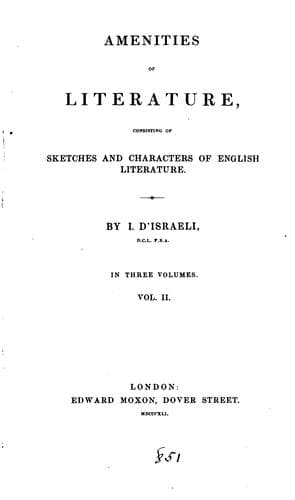
Amenities of Literature: Consisting of Sketches and Characters of English LiteratureDisraeli, Isaac
History
Amenities of Literature: Consisting of Sketches and Characters of English Literature
Disraeli, Isaac
Authors, English -- Biography; English literature -- History and criticism; Great Britain -- Intellectual life
The literary history of Sir THOMAS ELYOT exhibits the difficulties
experienced by a primitive author in the earliest attempts to open a new
path to the cultivation of a vernacular literature; and it seems to have
required all the magnanimity of our author to sustain his superiority
among his own circle, by disdaining their petulant criticism, and by the
honest confidence he gathered as he proceeded, in the successive
editions of his writings.
SKELTON.
At a period when satire had not yet assumed any legitimate form, a
singular genius appeared in Skelton. His satire is peculiar, but it is
stamped by vigorous originality. The fertility of his conceptions in his
satirical or his humorous vein is thrown out in a style created by
himself. The Skeltonical short verse, contracted into five or six, and
even four syllables, is wild and airy. In the quick-returning rhymes,
the playfulness of the diction, and the pungency of new words, usually
ludicrous, often expressive, and sometimes felicitous, there is a
stirring spirit which will be best felt in an audible reading. The
velocity of his verse has a carol of its own. The chimes ring in the
ear, and the thoughts are flung about like coruscations. But the magic
of the poet is confined to his spell; at his first step out of it he
falls to the earth never to recover himself. Skelton is a great creator
only when he writes what baffles imitation, for it is his fate, when
touching more solemn strains, to betray no quality of a poet--inert in
imagination and naked in diction. Whenever his muse plunges into the
long measure of heroic verse, she is drowned in no Heliconian stream.
Skelton seems himself aware of his miserable fate, and repeatedly, with
great truth, if not with some modesty, complains of
Mine homely rudeness and dryness.
But when he returns to his own manner and his own rhyme, when he riots
in the wantonness of his prodigal genius, irresistible and daring, the
poet was not unconscious of his faculty; and truly he tells,--
Though my rime be ragged,
Tattered and jagged,
Rudely rain-beaten,
Rusty, moth-eaten,
If ye take well therewith,
It hath in it some pith.
Public-domain text, read in full here on John Shaqi.
Reviews
Reviews
No reviews yet
Be the first to share your thoughts on this work.
Elsewhere in the archive
Join the Discussion
Join the discussion
Sign in to leave a comment or review.
Sign InorCreate an account