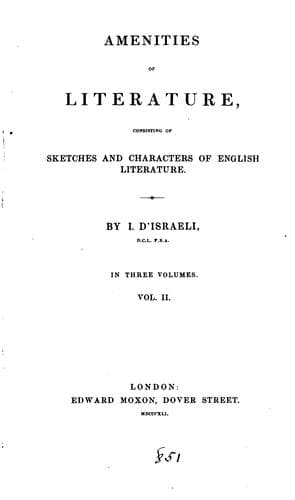
Amenities of Literature: Consisting of Sketches and Characters of English LiteratureDisraeli, Isaac
History
Amenities of Literature: Consisting of Sketches and Characters of English Literature
Disraeli, Isaac
Authors, English -- Biography; English literature -- History and criticism; Great Britain -- Intellectual life
Elyot had suffered some disappointments as a courtier in the days of
Wolsey, who lavished the royal favours on churchmen. In a letter to Lord
Cromwell, he describes himself with a very narrow income, supporting his
establishment, "equal to any knight in the country where I dwell who
have much more to live on;" but a new office, involving considerable
expense in its maintenance, to which he had been just appointed, he
declares would be his ruin, having already discharged "five honest and
tall personages."--"I wot not by what malice of fortune I am constrained
to be in that office, whereunto is, as it were, appendent loss of money
and good name, all sharpness and diligence in justice now-a-days being
everywhere odious." And this was at a time when "I trusted to live
quietly, and by little and little to repay my creditors, and _to
reconcile myself to mine old studies_."
This letter conveys a favourable impression of the real character of
this learned man; but Elyot had condescended abjectly to join with the
herd in the general scramble for the monastic lands; and if he feigned
poverty, the degradation is not less. There are cruel epochs in a great
revolution; moments of trial which too often exhibit the lofty
philosopher shrinking into one of the people. It is probable that he
succeeded in his petition, for I find his name among the commissioners
appointed to make a general inquiry after lands belonging to the Church,
as also to the colleges of the universities, in 1534.
But in this day of weakness Elyot sunk far lower than petitioning for
suppressed lands. Elyot was suspected of inclining to Popery, and being
adverse to the new order of affairs. His former close intimacy with Sir
Thomas More contributed to this suspicion, and now, it is sad to relate,
he renounces this ancient and honourable friendship! Peter denied his
Master. "I beseech your good lordship now to lay apart the remembrance
of the amity betwixt me and Sir Thomas More, which was but _usque ad
aras_, as is the proverb, considering that I was never so much addicted
unto him as I was unto truth and fidelity towards my sovereign lord."
Was the influence of such illustrious friendships to be confined to
chimney-corners? Had Elyot not listened to the wisdom, and revered the
immutable fortitude, of "his great friend and crony?"--he, the stern
moralist, who, in his "Governor," had written a remarkable chapter on
"the constancy of friends," and had illustrated that passion by the
romantic tale of Titus and Gesippus, where the personal trials of both
parties far exceed those of the Damon and Pythias of antiquity, and are
so eloquently developed and so exquisitely narrated by the great Italian
novelist.
Public-domain text, read in full here on John Shaqi.
Reviews
Reviews
No reviews yet
Be the first to share your thoughts on this work.
Elsewhere in the archive
Join the Discussion
Join the discussion
Sign in to leave a comment or review.
Sign InorCreate an account