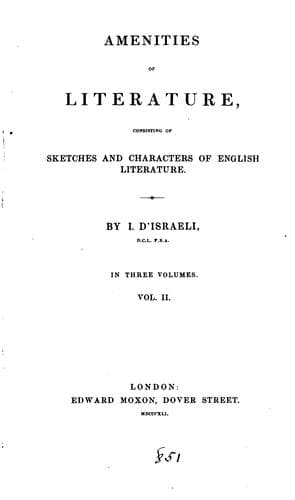
Amenities of Literature: Consisting of Sketches and Characters of English LiteratureDisraeli, Isaac
History
Amenities of Literature: Consisting of Sketches and Characters of English Literature
Disraeli, Isaac
Authors, English -- Biography; English literature -- History and criticism; Great Britain -- Intellectual life
Skelton was an ecclesiastic who was evidently among those who had
adopted the principles of reformation before the Reformation. With equal
levity and scorn he struck at the friars from his pulpit or in his
ballad, he ridiculed the Romish ritual, and he took unto himself that
wife who was to be called a concubine. To the same feelings we may also
ascribe the declamatory invective against Cardinal Wolsey, from whose
terrible arm he flew into the sanctuary of Westminster, where he
remained protected by Abbot Islip until his death, which took place in
1529, but a few short months before the fall of Wolsey. It is supposed
that the king did not wholly dislike the levelling of the greatness of
his overgrown minister; and it is remarkable that one of the charges
subsequently brought by the council in 1529 against Wolsey--his
imperious carriage at the council-board--is precisely one of the
accusations of our poet, only divested of rhyme; whence perhaps we may
infer that Skelton was an organ of the rising party.
"Why Come you not to Court?"--that daring state-picture of an omnipotent
minister--and "The Boke of Colin Clout," where the poet pretends only to
relate what the people talk about the luxurious clergy, and seems to be
half the reformer, are the most original satires in the language. In the
days when Skelton wrote these satires there appeared a poem known by the
title of "Reade me and be not Wrothe," a voluminous invective against
the Cardinal and the Romish superstitions, which has been ascribed by
some to Skelton. The writer was WILLIAM ROY, a friar; the genius, though
not the zeal, of ROY and SKELTON are far apart--as far as the buoyancy
of racy originality is removed from the downright earnestness of grave
mediocrity. Roy had been the learned assistant of Tyndale in the first
edition of the translation of the New Testament, and it was the public
conflagration at London of that whole edition which aroused his
indignant spirit. The satire, which had been printed abroad, was
diligently suppressed by an emissary of the Cardinal purchasing up all
the copies; and few were saved from the ravage;[5] the author, however,
escaped out of the country.
In "The Crown of Lawrell" Skelton has himself furnished a catalogue of
his numerous writings, the greater number of which have not come down to
us. Literary productions were at that day printed on loose sheets, or in
small pamphlets, which the winds seem to have scattered. We learn there
of his graver labours. He composed the "Speculum Principis" for his
royal pupil--
To bear in hand, therein to read,
and he translated Diodorus Siculus--
Six volumes engrossed, it doth contain.
Public-domain text, read in full here on John Shaqi.
Reviews
Reviews
No reviews yet
Be the first to share your thoughts on this work.
Elsewhere in the archive
Join the Discussion
Join the discussion
Sign in to leave a comment or review.
Sign InorCreate an account