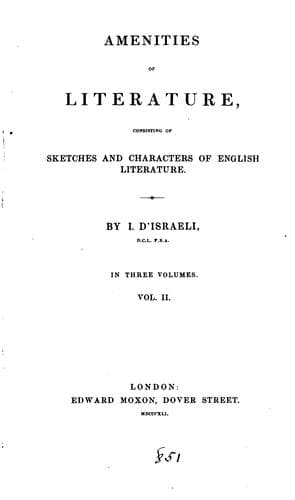
Amenities of Literature: Consisting of Sketches and Characters of English LiteratureDisraeli, Isaac
History
Amenities of Literature: Consisting of Sketches and Characters of English Literature
Disraeli, Isaac
Authors, English -- Biography; English literature -- History and criticism; Great Britain -- Intellectual life
To have composed a manual for the education of a prince, and to have
persevered through a laborious version, are sufficient evidence that the
learned Skelton had his studious days as well as his hours of caustic
jocularity. He appears to have written various pieces for the court
entertainment; but for us exists only an account of the interlude of the
"Nigramansir," in the pages of Warton, and a single copy of the goodly
interlude of "Magnificence,"[6] in the Garrick collection. If we accept
his abstract personations merely as the names, and not the qualities of
the dramatic personages, "Magnificence" approaches to the true vein of
comedy.
Skelton was, however, probably more gratified by his own Skeltonical
style, moulding it with the wantonness of power on whatever theme, comic
or serious. In a poem remarkable for its elegant playfulness, a very
graceful maiden, whose loveliness the poet has touched with the most
vivid colouring, grieving over the fate of her sparrow from its feline
foe, chants a dirige, a paternoster, and an Ave Maria for its soul, and
the souls of all sparrows. In this discursive poem, which glides from
object to object, in the vast abundance of fancy, a general mourning of
all the birds in the air, and many allusions to the old romances,
"Philip Sparrow," for its elegance, may be placed by the side of
Lesbia's Bird, and, for its playfulness, by the Vert Vert of Gresset.
But Skelton was never more vivid than in his Ale-wife, and all
The mad mummyng
Of Elynour Rummyng,--
a piece which has been more frequently reprinted than any of his works.
It remains a morsel of poignant relish for the antiquary, still
enamoured of the portrait of this grisly dame of Leatherhead, where her
name and her domicile still exist. Such is the immortality a poet can
bestow.[7] "The Tunnyng of Elynoure Rummyng" is a remarkable production
of THE GROTESQUE, or the low burlesque; the humour as low as you please,
but as strong as you can imagine. Cleland is reported, in Spence's
Anecdotes of Pope, to have said, that this "Tunnyng of Elynoure Rummyng"
was taken from a poem of Lorenzo de' Medici. There is indeed a jocose
satire by that noble bard, entitled "I Beoni," the Topers; an elegant
piece of playful humour, where the characters are a company of thirsty
souls hastening out of the gates of Florence to a treat of excellent
wine. It was printed by the Giunti, in 1568,[8] and therefore this
burlesque piece could never have been known to Skelton. The manners of
our Alewife and her gossips are purely English, and their contrivances
to obtain their potations such as the village of Leatherhead would
afford.
Public-domain text, read in full here on John Shaqi.
Reviews
Reviews
No reviews yet
Be the first to share your thoughts on this work.
Elsewhere in the archive
Join the Discussion
Join the discussion
Sign in to leave a comment or review.
Sign InorCreate an account