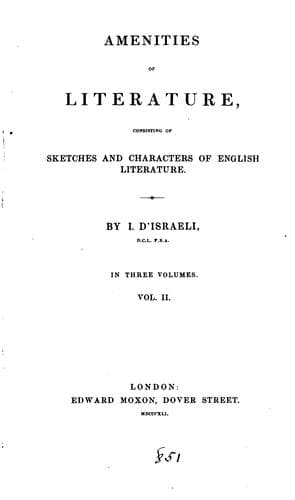
Amenities of Literature: Consisting of Sketches and Characters of English LiteratureDisraeli, Isaac
History
Amenities of Literature: Consisting of Sketches and Characters of English Literature
Disraeli, Isaac
Authors, English -- Biography; English literature -- History and criticism; Great Britain -- Intellectual life
[1] George Ellis, although an elegant critic, could not relish "the
Skeltonical minstrelsy." In an extract from a manuscript poem
ascribed to Skelton, "The Image of Hypocrisy," and truly Skeltonical
in every sense, he condemned it as "a piece of obscure and
unintelligible ribaldry;" and so, no doubt, it has been accepted. But
the truth is, the morsel is of exquisite poignancy, pointed at Sir
Thomas More's controversial writings, to which the allusions in every
line might be pointed out. As these works were written after the
death of Skelton, the merit entirely remains with this fortunate
imitator.
In the public rejoicings at the defeat of the Armada, in 1589, a
ludicrous bard poured forth his patriotic effusions in what he called
"A Skeltonical Salutation, or Condign Gratulation," of the Spaniard,
who, he says,--
----In a bravado,
Spent many a crusado.
In a reprint of the poem of "Elynoure Rummynge," in 1624, which may
be found in the "Harl. Miscellany," vol. i., there is a poem prefixed
which ridicules the lovers of tobacco; this anachronism betrays the
imitator. At the close there are some verses from the Ghost of
Skelton; but we believe it is a real ghost.
[2] Sterne.
[3] Henry Bradshaw. "Warton," iii. 13.
[4] Thomas Churchyard.
[5] After the death of the Cardinal it was reprinted, in 1546; but
the satire was weakened, being transferred from Wolsey and wholly
laid on the clergy. The very rare first edition is reprinted in the
"Harleian Miscellany," by Parke, vol. ix. Tyndale has reproached his
colleague with being somewhat artful and mutable in his friendships;
but the wandering man proved the constancy of his principles, for as
a heretic he perished at the stake in Portugal.
[6] It has passed through a reprint by the Roxburgh Club.
[7] A noble amateur laid on the shrine of this antiquated beauty
20_l._ to possess her rare portrait; and, on the republication of
this portrait, Steevens wrote some sarcastic verses on the
print-collectors in the "European Mag." 1794; they show this famous
commentator to have been a polished wit, though he pronounced the
Sonnets of Shakspeare unreadable. These verses have been reprinted in
"Dibdin's Bibliomania."
[8] Roscoe's "Lorenzo de' Medici," i. 290.
Public-domain text, read in full here on John Shaqi.
Reviews
Reviews
No reviews yet
Be the first to share your thoughts on this work.
Elsewhere in the archive
Join the Discussion
Join the discussion
Sign in to leave a comment or review.
Sign InorCreate an account