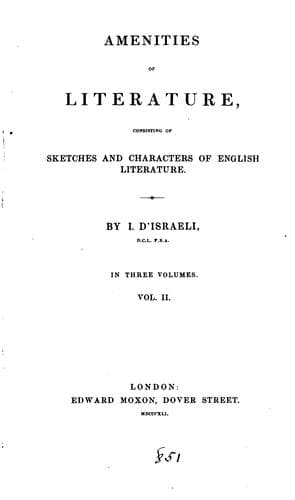
Amenities of Literature: Consisting of Sketches and Characters of English LiteratureDisraeli, Isaac
History
Amenities of Literature: Consisting of Sketches and Characters of English Literature
Disraeli, Isaac
Authors, English -- Biography; English literature -- History and criticism; Great Britain -- Intellectual life
The latest edition of Skelton was published in the days of Pope, which
occasioned some strictures in conversation from the great poet. The
laureated poet of Henry the Eighth is styled "beastly;" probably Pope
alluded to this minute portrait of "Elynoure Rummynge" and her crowd of
customers. Beastliness should have been a delicate subject for censure
from Pope. But surely Pope had never read Skelton; for could that great
poet have passed by the playful graces of "Philip Sparrow" only to
remember the broad gossips of "Elynoure Rummyng?"
The amazing contrast of these two poems is the most certain evidence of
the extent of the genius of the poet; he who with copious fondness dwelt
on a picture which rivals the gracefulness of Albano, could with equal
completeness give us the drunken gossipers of an Ostade. It is true that
in the one we are more than delighted, and in the other we are more than
disgusted; but in the impartiality of philosophical criticism, we must
award that none but the most original genius could produce both. It is
this which entitles our bard to be styled the "Inventive Skelton."
But are personal satires and libels of the day deserving the attention
of posterity? I answer, that for posterity there are no satires nor
libels. We are concerned only with human nature. When the satirical is
placed by the side of the historical character, they reflect a mutual
light. We become more intimately acquainted with the great Cardinal, by
laying together the satire of the mendacious Skelton with the domestic
eulogy of the gentle Cavendish. The interest which posterity takes is
different from that of contemporaries; our vision is more complete; they
witnessed the beginnings, but we behold the ends. We are no longer
deceived by hyperbolical exaggeration, or inflamed by unsparing
invective; the ideal personage of the satirist is compared with the real
one of the historian, and we touch only delicate truths. What Wolsey was
we know, but how he was known to his own times, and to the people, we
can only gather from the private satirist; corrected by the passionless
arbiter of another age, the satirist becomes the useful historian of the
man.
The extraordinary combination in the genius of Skelton was that of two
most opposite and potent faculties--the hyperbolical ludicrous masking
the invective. He acts the character of a buffoon; he talks the language
of drollery; he even mints a coinage of his own, to deepen the colours
of his extravagance--and all this was for the people! But his hand
conceals a poniard; his rapid gestures only strike the deeper into his
victim, and we find that the Tragedy of the State has been acted while
we were only lookers-on before a stage erected for the popular gaze.[9]
FOOTNOTES:
Public-domain text, read in full here on John Shaqi.
Reviews
Reviews
No reviews yet
Be the first to share your thoughts on this work.
Elsewhere in the archive
Join the Discussion
Join the discussion
Sign in to leave a comment or review.
Sign InorCreate an account