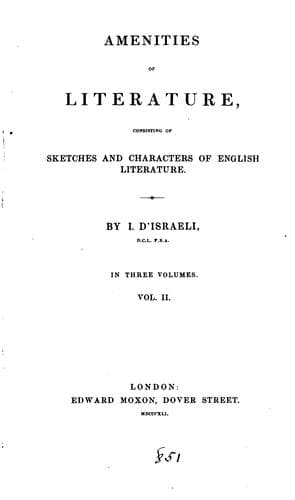
Amenities of Literature: Consisting of Sketches and Characters of English LiteratureDisraeli, Isaac
History
Amenities of Literature: Consisting of Sketches and Characters of English Literature
Disraeli, Isaac
Authors, English -- Biography; English literature -- History and criticism; Great Britain -- Intellectual life
In the eclogues of Barclay, the country is ever represented in an
impoverished, depressed state; and the splendour of the city, and the
luxurious indulgence of the citizen and the courtier, offer a singular
contrast to the extreme misery of the agriculturist. We may infer that
the country had been deplorably ravaged or neglected in the civil wars,
which, half a century afterwards, was to be covered by the fat beeves of
the graziers of Elizabeth.
FOOTNOTES:
[1] The woodcuts in this edition are wretched; though in part they
are copied from the fine specimens of the art which embellish the
Latin version of Locherus.
[2] One of these, a "Dialogue between a Citizen and Uplandishman,"
has been reprinted by the Percy Society, under the editorship of Mr.
Fairholt, who has given a digest of the other Eclogues in a
Preface.--ED.
THE PSYCHOLOGICAL CHARACTER OF SIR THOMAS MORE.
If the art of biography be the development of "the ruling passion," it
is in strong characters that we must seek for the single feature.
Learned and meditative as was Sir THOMAS MORE, a jesting humour, a
philosophical jocundity, indulged on important as well as on ordinary
occasions, served his wise purpose. He seems to have taken refuge from
the follies of other men by retreating to the pleasantry of his own.
Grave men censured him for the absence of all gravity; and some imagined
that the singularity of his facetious disposition, which sometimes
seemed even ludicrous, was carried on to affectation. It was certainly
inherent,--it was a constitutional temper--it twined itself in his
fibres,--it betrayed itself on his countenance. We detect it from the
comic vein of his boyhood when among the players; we pursue it through
the numerous transactions of his life; and we leave him at its last
solemn close, when life and death were within a second of each other,
uttering three jests upon the scaffold. Even when he seemed to have
quitted the world, and had laid his head on the block, he bade the
executioner stay his hand till he had removed his beard, observing,
"that that had never committed any treason."
Public-domain text, read in full here on John Shaqi.
Reviews
Reviews
No reviews yet
Be the first to share your thoughts on this work.
Elsewhere in the archive
Join the Discussion
Join the discussion
Sign in to leave a comment or review.
Sign InorCreate an account