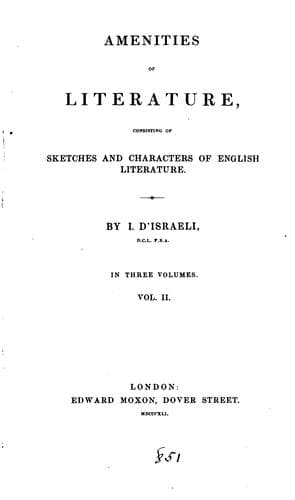
Amenities of Literature: Consisting of Sketches and Characters of English LiteratureDisraeli, Isaac
History
Amenities of Literature: Consisting of Sketches and Characters of English Literature
Disraeli, Isaac
Authors, English -- Biography; English literature -- History and criticism; Great Britain -- Intellectual life
If man in society changes his manners, he cannot vary his species; man
remains nothing but man; for, however disguised by new modes of acting,
the same principles of our actions are always at work. The same follies
and the same vices in their result actuate the human being in all ages;
and he who turns over the volume of the learned civilian of Germany will
find detailed those great moral effects in life which, if the modern
moralist may invest with more dignity, he could not have discovered with
more truth. We have outgrown his counsels, but we never shall elude the
vexatious consequences of his experience; and many a chapter in the
"Ship of Fools" will point many an argument _ad hominum_, and awaken in
the secret hours of our reminiscences the pang of contrite sorrows, or
tingle our cheek with a blush for our weaknesses. The truths of human
nature are ever echoing in our breasts.
"The Ship of Fools," by Alexander Barclay--a volume of renown among
literary antiquaries, and of rarity and price--is at once a translation
and an original. In octave stanza, flowing in the ballad measure,
Barclay has a natural construction of style still retaining a vernacular
vigour. He is noticed by Warton for having contributed his share in the
improvement of English phraseology; and, indeed, we are often surprised
to discover many felicities of our native idiom; and the work, though it
should be repulsive to some for its black-letter, is perfectly
intelligible to a modern reader. The verse being prosaic, preserves its
colloquial ease, though with more gravity than suits sportive subjects;
we sometimes feel the tediousness of the good sense of the Priest of St.
Mary Ottery.
The edition of 1570 of the "Ship of Fooles"[1] contains other
productions of Barclay. In his "Eclogues,"[2] our good priest, who did
not write, as he says, "for the laud of man," indulged his ethical and
theological vein in pastoral poetry; and the interlocutors are citizens
disputing with men of the country, and poets with their patrons. To have
converted shepherds into scholastic disputants or town-satirists was an
unnatural change; but this whimsical taste had been introduced by
Petrarch and Mantuan; and the first eclogues in the English language,
which Warton tells us are those of Barclay, took this strange form--an
incongruity our Spenser had not the skill to avoid, and for which Milton
has been censured. The less fortunate anomalies of genius are often
perpetuated by the inconsiderate imitation of those who should be most
sensible of their deformity.
Public-domain text, read in full here on John Shaqi.
Reviews
Reviews
No reviews yet
Be the first to share your thoughts on this work.
Elsewhere in the archive
Join the Discussion
Join the discussion
Sign in to leave a comment or review.
Sign InorCreate an account