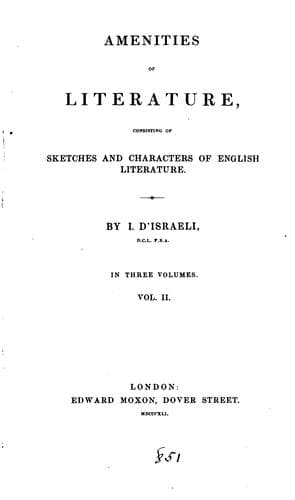
Amenities of Literature: Consisting of Sketches and Characters of English LiteratureDisraeli, Isaac
History
Amenities of Literature: Consisting of Sketches and Characters of English Literature
Disraeli, Isaac
Authors, English -- Biography; English literature -- History and criticism; Great Britain -- Intellectual life
MORE replied to "The Supplication of the Beggars" by "The Supplications
of the Souls in Purgatory." These he represented in terror at the
sacrilegious annihilation of the masses said for their repose; and this
with the Romanist was probably no weak argument in that day.
MORE more reasonably ridicules the extravagance of the estimates. Such
accounts, got up in haste and designed for a particular purpose, are
necessarily inaccurate; but the inaccuracy of a statement does not at
all injure the drift of the argument, should that be based on truth.
With MORE "the heretics" were but ordinary rebels, as appears by the
style of his narrative. "A rabble of heretics at Abingdon did not intend
to lose any more labour by putting up bills (petitions) to Parliament,
but to make an open insurrection and subvert all the realm, to kill the
clergy, and sell priests' heads as good and cheap as sheep's
heads--three for a penny, buy who would! But God saved the church and
the realm. Yet after this was there one John Goose roasted at
Tower-hill, and thereupon some other John Goose began to make some
gaggling awhile, but it availed him not. And now we have this gosling
with his 'Supplication of Beggars.' He maketh his bill in the name of
the beggars. The bill is couched as full of _lies_ as the beggar
swarmeth full of _lice_. We neither will nor shall need to make much
business about this matter; we trust much better in the goodness of good
men."
The marriage of the clergy was no doubt at first abused by some. MORE
describes one Richard Mayfield, late a monk and a priest, and, it may be
added, a martyr, for he was burned. Of this man he says, "His holy life
well declares his heresies, when being both a priest and a monk he went
about two wives, one in Brabant, another in England. What he meant I
cannot make you sure, whether he would be sure of the one if t'other
should happen to refuse him, or that he would have them both, the one
here, the other there; or else both in one place, the one because he was
priest, the other because he was monk."[7]
Such is the ludicrous ribaldry which runs through the polemical works of
Sir THOMAS MORE: the opposite party set no better example, and none
worse than the redoubtable Simon Fish, the writer of the "Supplication
of Beggars." Oldmixon expresses his astonishment that "the famous Sir
Thomas More was so hurried by his zeal that he forgot he was a
gentleman, and treated Mr. Fish with the language of a monk."
Public-domain text, read in full here on John Shaqi.
Reviews
Reviews
No reviews yet
Be the first to share your thoughts on this work.
Elsewhere in the archive
Join the Discussion
Join the discussion
Sign in to leave a comment or review.
Sign InorCreate an account