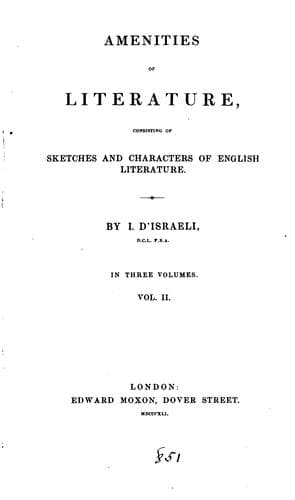
Amenities of Literature: Consisting of Sketches and Characters of English LiteratureDisraeli, Isaac
History
Amenities of Literature: Consisting of Sketches and Characters of English Literature
Disraeli, Isaac
Authors, English -- Biography; English literature -- History and criticism; Great Britain -- Intellectual life
Writers who decide on other men and on other times by the spirit of
their own, try human affairs by a false standard. MORE was at heart a
monk. He wore a prickly hair-shirt to mortify the flesh; he scourged
himself with the knotted cord; he practised the penance; and he appeals
to miraculous relics as the evidences of his faith! I give his own words
in alluding to the Sudarium, that napkin sent to king Abgarus, on which
Jesus impressed the image of his own face: "And it hath been by like
miracle in the thin corruptible cloth kept and preserved these 1500
years fresh and well preserved, to the inward comforts, spiritual
rejoicing, and great increase of fervour in the hearts of good Christian
people." To this he joins another similar miraculous relic, "the
evangelist Luke's portrait of our blessed Lady, his mother."[8]
Such were considered as the evidences of the true faith of the
Romanists; but MORE with his relics was then dealing in a damaged
commodity. Lord Herbert has noticed the great fall of the price of
relics at the dissolution of the monasteries: some which had been left
in pawn no one cared to redeem.
"The History of King Richard the Third," which first appeared in a
correct state in this folio, has given rise to "historic doubts" which
led to some paradoxes. The personal monster whom MORE and SHAKSPEAKE
exhibited has vanished, but the deformity of the revolting parricide was
surely revealed in the bones of the infant nephews. This, the earliest
history in our vernacular literature, may still be read with delight. As
a composition the critical justice of Lord Orford may be cited. "Its
author was then in the vigour of his fancy, and fresh from the study of
the Greek and Roman historians, whose manner he has imitated." The
details in this history of a prince of the house of York, though they
may be tinged with the gall of the Lancastrian Cardinal Morton, descend
to us with the weight of contemporary authority. It is supposed that
MORE may have derived much of the materials of his history from his
early patron, but the charms which still may retain us are the natural
yet dramatic dialogue--the picturesque touches--and a style, at times,
whose beauty three centuries have not wrinkled--and the emotions which
such vital pages leave in the reader's mind.[9]
Public-domain text, read in full here on John Shaqi.
Reviews
Reviews
No reviews yet
Be the first to share your thoughts on this work.
Elsewhere in the archive
Join the Discussion
Join the discussion
Sign in to leave a comment or review.
Sign InorCreate an account