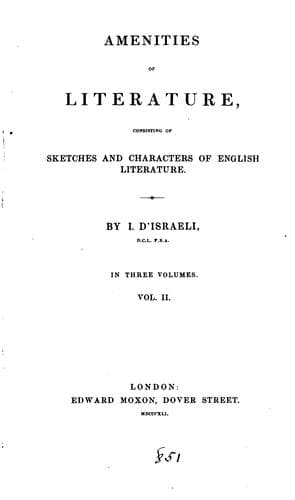
Amenities of Literature: Consisting of Sketches and Characters of English LiteratureDisraeli, Isaac
History
Amenities of Literature: Consisting of Sketches and Characters of English Literature
Disraeli, Isaac
Authors, English -- Biography; English literature -- History and criticism; Great Britain -- Intellectual life
Burnet, in his translation, cautiously reminds his readers
that he must in nowise be made responsible for the matter of the work
which "he ventured" to translate. Others have conceived "the Utopia"
dangerous for those speculators in politics who might imagine the author
to have been serious. MORE himself has adjudged the book "no better
worthy than to lye always in his own island, or else to be consecrated
to Vulcan."
But assuredly many of the extraordinary principles inculcated in "the
Utopia" were not so lightly held by its illustrious author. The
sincerity of his notions may be traced in his own simple habits, his
opinions in conversation, and the tenor of his invariable life. His
contempt of outward forms and personal honours, his voluntary poverty,
his fearlessness of death--all these afford ample evidence that the
singularity of the man himself was as remarkable as the work he
produced. The virtues he had expatiated on, he had contemplated in his
own breast.
This singular, but great man, was a sage whose wisdom lay concealed in
his pleasantry; a politician without ambition; a lord chancellor who
entered into office poor, and left it not richer. When his house was to
be searched for treasure, which circumstance had alarmed his friends,
well did that smile become him when he observed that "it would be only a
sport to his family," and he pleasantly added, "lest they should find
out my wife's gay girdle and her gold beads." When the clergy, in
convention, had voted a donation amounting to no inconsiderable fortune,
"not for services to be performed, but for those which he had chosen to
do," More rejected the gift with this noble confession--"I am both
over-proud, and over-slothful also, to be hired for money to take half
the labour and business in writing that I have taken since I began." And
when accused by Tyndale and others for being "the proctor of the
clergy," and richly fed, how forcible was his expression! "He had
written his controversial works only that God might give him thanks."
It happened, however, that his after-conduct in life, in regard to that
religious toleration which he had wisely maintained in his ideal
society, was as opposite as night to noon. Could he then have ever been
earnest in his "Utopia?"--he who exults over the burning of a heretic,
who "could not agree that before the day of doom there were either any
saint in heaven or soul in purgatory, or in hell either," for which
horrible heresy he was delivered at last into the secular hands, and
"burned as there was never wretch I ween better worth."[11] This
harmless and hapless metaphysical theologian did not disagree with More
on the existence of saints, of souls, nor of hell. The heretic
conceived--and could he change by volition the ideas which seemed to him
just?--that no reward or punishment could be inflicted before the final
judgment. A conversation of five minutes might have settled the
difference, for they only varied about the precise time!
Public-domain text, read in full here on John Shaqi.
Reviews
Reviews
No reviews yet
Be the first to share your thoughts on this work.
Elsewhere in the archive
Join the Discussion
Join the discussion
Sign in to leave a comment or review.
Sign InorCreate an account