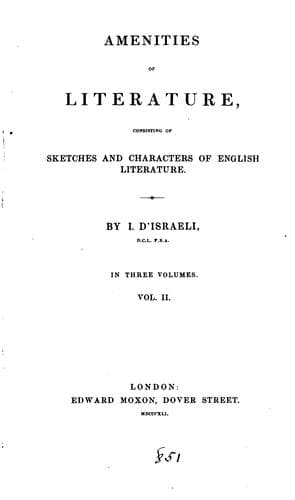
Amenities of Literature: Consisting of Sketches and Characters of English LiteratureDisraeli, Isaac
History
Amenities of Literature: Consisting of Sketches and Characters of English Literature
Disraeli, Isaac
Authors, English -- Biography; English literature -- History and criticism; Great Britain -- Intellectual life
In that great revolution which was just opening in his latter days, MORE
seems sometimes to have mistaken theology for politics. A strange and
mysterious change, such as the history of man can hardly parallel,
occurred in the mind of MORE, by what insensible gradations is a secret
which must lie in his grave.
This great man laid his head on the block to seal his conscience with
his blood. Protestants have lamented this act as his weakness, the
Romanists decreed a martyrdom. In a sudden change of system in the
affairs of a nation, when even justice may assume the appearance of
violence, the most enlightened minds, standing amidst their ancient
opinions and their cherished prejudices subverted, display how the
principle of integrity predominates over that of self-preservation.
FOOTNOTES:
[1] "Sir Thomas More's Workes," 127.
[2] "The Workes of Sir Thomas More in the English Tongue, 1557, fo.,"
a venerable folio of nearly 1500 pages in double columns, is closely
printed in black-letter.
[3] Roper's "Life of Sir Thomas More," which had been suppressed
through the reign of Elizabeth, only first appeared in 1626, at
Paris, when a Roman Catholic princess in the person of Henrietta, the
queen of Charles the First, had ascended the throne of England; it
was republished in 1729. There is also an elegant modern reprint by
Mr. Singer.
[4] The Life by his great-grandson was printed in 1627, and
republished in 1726. This biography is the one usually referred to.
Though with a more lucid arrangement, and a fuller narrative, than
Roper's life, the writer inherited little of the family genius,
except the bigotry of his great ancestor.
[5] _Tres Thomæ._ The three Thomases are, Aquinas, à Becket, and
More--by Dr. Thomas Stapleton. Another Life by J. H. is an
abridgment, 1662. These writers, Romanists, as well as the
great-grandson, have interspersed in their narrative more than one of
those fabulous incidents and pious frauds, visions, and miracles,
which have been the opprobrium of Catholic biographers.
[6] Macdiarmid, in his "Lives of British Statesmen," has chiefly
considered the political character of this Lord-Chancellor. Others
have written lives merely as accompaniments to the editions of some
of his works.
[7] Works, fo. 346.
[8] "Works of Sir Thomas More," 113, col. 2.
[9] Mr. Singer has furnished us with a correct reprint of this
history. More's "Life of Richard the Third" had been given by our
chroniclers from copies mutilated or altered. A work whose merits
arise from the beauty of its composition admits of neither.
Public-domain text, read in full here on John Shaqi.
Reviews
Reviews
No reviews yet
Be the first to share your thoughts on this work.
Elsewhere in the archive
Join the Discussion
Join the discussion
Sign in to leave a comment or review.
Sign InorCreate an account