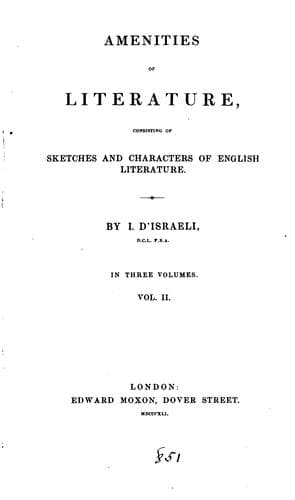
Amenities of Literature: Consisting of Sketches and Characters of English LiteratureDisraeli, Isaac
History
Amenities of Literature: Consisting of Sketches and Characters of English Literature
Disraeli, Isaac
Authors, English -- Biography; English literature -- History and criticism; Great Britain -- Intellectual life
[10] The old translation, "by Raphe Robinson, 1551," has been
republished by Dr. Dibdin, accompanied by copious annotations. Almost
everything relating to the family, the life, and the works of the
author may be found in "the biographical and literary introduction."
It is the first specimen of an edition where the diligence of the
editor has not been wasted on trivial researches or nugatory
commentaries.
[11] "Sir Thomas More's Workes," 348.
THE EARL OF SURREY AND SIR THOMAS WYATT.
Not many years intervened between the uncouth gorgeousness of HAWES, the
homely sense of BARCLAY, the anomalous genius of SKELTON, and the pure
poetry of Henry Howard the EARL of SURREY. In the poems of SURREY, and
his friend, Sir Thomas Wyatt,[1] the elder, the age of taste, if not of
genius, opens on us. Dryden and Pope sometimes seem to appear two
centuries before their date. There is no chronology in the productions
of real genius; for, whenever a great master appears, he advances his
art to a period which labour, without creation, toils for centuries to
reach.
The great reformer of our poetry, he who first from his own mind,
without a model, displayed its permanent principles, was the poetic Earl
of Surrey. There was inspiration in his system, and he freed his genius
from the barbaric taste or the undisturbed dulness which had prevailed
since the days of Chaucer. His ear was musical, and he formed a metrical
structure with the melodies of our varied versification, rejecting the
rude rhythmical rhyme which had hitherto prevailed in our poetry. He
created a poetic diction, and graceful involutions; a finer selection of
words, and a delicacy of expression, were now substituted for vague
diffusion, and homeliness of phrases and feeble rhymes, or, on the other
hand, for that vitiated style of crude pedantic Latinisms, such as
"purpúre, aureáte, pulchritúde, celatúre, facúnde," and so many others,
laborious nothings! filling the verse with noise. The contemplative and
tender SURREY charms by opening some picturesque scene or dwelling on
some impressive incident. He had discerned the error of those
inartificial writers, whose minute puerility, in their sterile
abundance, detailed till nothing was remembered, and described, till
nothing was perceptible. Hitherto, our poets had narrowed their powers
by moulding their conceptions by temporary tastes, the manners and modes
of thinking of their day; but their remoteness, which may delight the
antiquary, diminishes their interest with the poetical reader. SURREY
struck into that secret path which leads to general nature, guided by
his art: his tenderness and his thoughtful musings find an echo in our
bosoms, and are as fresh with us as they were in the court of Windsor
three centuries past.
Public-domain text, read in full here on John Shaqi.
Reviews
Reviews
No reviews yet
Be the first to share your thoughts on this work.
Elsewhere in the archive
Join the Discussion
Join the discussion
Sign in to leave a comment or review.
Sign InorCreate an account