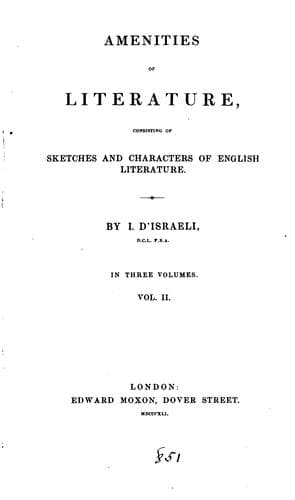
Amenities of Literature: Consisting of Sketches and Characters of English LiteratureDisraeli, Isaac
History
Amenities of Literature: Consisting of Sketches and Characters of English Literature
Disraeli, Isaac
Authors, English -- Biography; English literature -- History and criticism; Great Britain -- Intellectual life
Surrey and Wyatt, though often engaged, the one as a statesman, the
other as a general, found their most delightful avocation in the
intercourse of their studies. Their minds seemed cast in the same mould.
They mutually confided their last compositions, and sometimes chose the
same subject in the amicable wrestlings of their genius. It was a
community of studies and a community of skill; the thoughts of the one
flowed into the thoughts of the other, and we frequently discover the
verse from one in the poem of the other. Wyatt was the more fortunate
man, for he did not live to see himself die in the partner of his fame
perishing on a scaffold, and he has received a poet's immortality from
that friend's noble epitaph. In his epitaph, Surrey dwells on every
part of the person of his late companion; he expatiates on the
excellences of the head, the face, the hand, the tongue, the eye, and
the heart--but these are not fanciful conceits; the solemnity of his
thoughts and his deep emotions tell their truth. Wyatt's was
A head, where Wisdom's mysteries did frame,
Whose hammers beat still in that lively brain,
As on a stithy,[4] where some work of fame
Was daily wrought.
FOOTNOTES:
[1] "The Works of the Earl of Surrey and Sir Thomas Wyatt," by Dr.
Nott, form an important accession to our national literature. If we
cannot always agree with the conclusions of our literary antiquary,
we must value the variety of his researches, not less profound than
extensive.
[2] "Tiraboschi," vol. vii.--Haym's "Bibliotheca Italiani." When
Conybeare communicated the same information to Dr. Bliss, it must
have been derived from Warton.
[3] And, strange to add, it is still history! Mr. Godwin, in "The
Lives of Necromancers," details every part of this apocryphal tale!
And the Edinburgh reviewer very philosophically, not doubtful of its
verity, accounts for all its supernatural magic, and clearly explains
the inexplicable!
[4] The smith's forge.
THE SPOLIATION OF THE MONASTERIES.
Public-domain text, read in full here on John Shaqi.
Reviews
Reviews
No reviews yet
Be the first to share your thoughts on this work.
Elsewhere in the archive
Join the Discussion
Join the discussion
Sign in to leave a comment or review.
Sign InorCreate an account