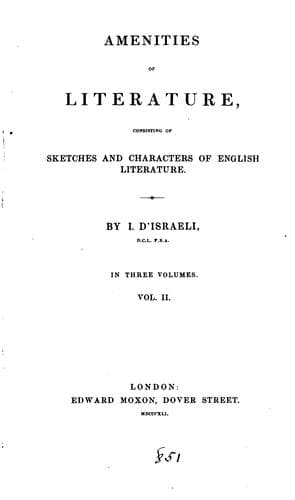
Amenities of Literature: Consisting of Sketches and Characters of English LiteratureDisraeli, Isaac
History
Amenities of Literature: Consisting of Sketches and Characters of English Literature
Disraeli, Isaac
Authors, English -- Biography; English literature -- History and criticism; Great Britain -- Intellectual life
Incidents of such an overwhelming nature in political history as are
those of the Reformation can have no sudden origin. They are but the
consequences of something which has preceded. In our country the
suppression of the monasteries and the abbeys had been long prepared; it
was not, and it could not have been, the temporary passions, nor the
absolute will, of an arbitrary monarch, which by a word could have
annihilated an awful power, had not the royal edict been but the echo of
many voices. It was attacking but an aged power dissolving in its own
corruption, which, blind with pride, looked with complacency on its own
unnatural greatness, its political anasarca. Its opulence was an object
it could not conceal from its enviers, and its paramount eminence was
too heavy a yoke for its rising rivals. This power, in the language of
the times, had "covered the land with an Egyptian darkness," and when
appeared the "Godly and learned king," as the eighth Henry was called,
he was saluted as "a Moses who delivered them from the bondage of
Pharaoh." It is not therefore strange that the act which at a single
blow annihilated the monastic orders and their "lands and tenements,"
was hailed as the most patriotic which had been ever passed by an
English sovereign. It made even a tyrannous and jealous monarch, who cut
off more heads of men and women than any other on record, popular and
extolled even in his latter days.
Henry the Eighth had paused at the blow he was about to level. The
plunder was too monstrous even for the hand of an arbitrary monarch. Its
division among the nobility and gentry was an expedient which removed
the odium from royalty, and invested it with that munificence which
dazzled the pride of Henry. In the vast harvest, the king refused the
lion's share, looking for his safer portion in the secure loyalty of the
new possessors to whom he transferred this vast and novel wealth.
Public-domain text, read in full here on John Shaqi.
Reviews
Reviews
No reviews yet
Be the first to share your thoughts on this work.
Elsewhere in the archive
Join the Discussion
Join the discussion
Sign in to leave a comment or review.
Sign InorCreate an account