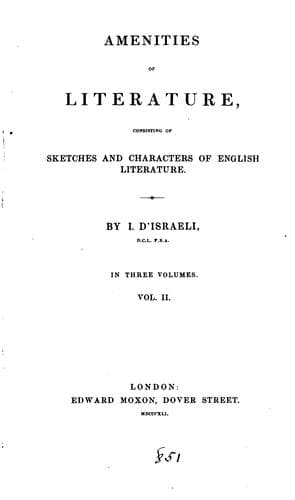
Amenities of Literature: Consisting of Sketches and Characters of English LiteratureDisraeli, Isaac
History
Amenities of Literature: Consisting of Sketches and Characters of English Literature
Disraeli, Isaac
Authors, English -- Biography; English literature -- History and criticism; Great Britain -- Intellectual life
Henry the Eighth rejected the Pope, but surely he died a Romanist. His
unwieldy huge form was lifted up from his death-bed that he might
prostrate himself, and, in the writer's language, who, however, was a
papist, "bury himself in the earth," to testify his reverence for "the
real presence," when it was brought before him. His will, which, though
it was put aside, was not the less the king's will, attested his last
supplications to "the Virgin Mary, and all her holy company of Heaven."
And he endowed an altar at Windsor, "to be honourably kept up with all
things necessary for _a daily mass_, there to be read _perpetually while
the world shall endure_." At the same time Henry endowed the poor
knights of Windsor, upon condition that they should repeat their
eternal masses for his soul. His magnificence was proportionate to his
sins; but his perpetual masses, and the world, did not endure together.
With this fact before us, it is not therefore strange that foreign
historians should have declared that our Henry the Eighth never designed
a Reformation, that he altered nothing; and had only raised a schism
which those who contest the papal sovereignty in their civil affairs, as
the Gallican Church affected to do, would incline more to approve than
to censure.
This monarch has been lauded as a patriot king for the suppression of
the monasteries and the national emancipation from the tiara--but
patriotism has often covered the most egotistical motives.
FOOTNOTES:
[1] A fear of the restitution of these abbey-lands to their former
uses appears to have prevailed long after their alienation. So late
as in the reign of James the First, the founder of Dulwich College,
in a dispute respecting the land, observes hypothetically--"If the
State should be at any time pleased to returne all abbey lands to
their former use, I must lose Dulwich, for which I have paid now
5000_l._" At a later revolution, when the bishops' lands were seized
on by the parliamentarians, many obtained those lands at easy rates,
or at no rate at all; the greater part reverted, but, if I am not
misinformed, there are still descendants of some of these
parliamentarians who hold estates without title-deeds.
[2] See an abstract from one of his Proclamations in "Curiosities of
Literature," vol. iii. p. 373.--ED.
[3] This alludes to the well-known story of the old priest, who
having blunderingly used _mumpsimus_ for _sumpsimus_, would never be
put right, alleging that "he hated all novelties."
A CRISIS AND A REACTION. ROBERT CROWLEY.
There is a state of transition in society which we usually call a
crisis. A crisis is the most active moment of conflicting principles;
the novel must extirpate the ancient, the ancient must eject the novel;
the one looks to be continued and the other to be settled; it is a
painful state of obstinate resistance, like that of two wrestlers when
neither can cast down the other.
Public-domain text, read in full here on John Shaqi.
Reviews
Reviews
No reviews yet
Be the first to share your thoughts on this work.
Elsewhere in the archive
Join the Discussion
Join the discussion
Sign in to leave a comment or review.
Sign InorCreate an account