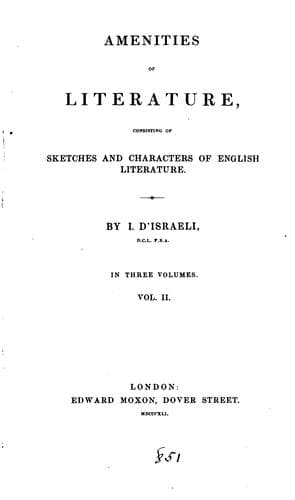
Amenities of Literature: Consisting of Sketches and Characters of English LiteratureDisraeli, Isaac
History
Amenities of Literature: Consisting of Sketches and Characters of English Literature
Disraeli, Isaac
Authors, English -- Biography; English literature -- History and criticism; Great Britain -- Intellectual life
In the last years of his reign, Henry vacillated in his uncertain
reform. Sometimes leaning on one party and sometimes on another; he had
lost the vigour of his better days. In his last parliament, though not
without some difficulty, both from Protestant and Papist, they had voted
for "the augmentation" of the royal revenue, their grant of the
chantries. These chantries were the last wrecks of the monastic lands. A
single church had often several chantries attached to it. Chantries were
endowments of estates by the sinners of that age for the benefit of
having eternal masses sung for their departed souls. Henry on this
occasion, in his last speech, strongly animadverts on the national
disunion; and among his thanks mingles his menaces "to unite them in a
more unacceptable way" than the tenderness with which at that moment he
addressed them, for their concessions to his "Court of Augmentation."
It is also evident, by this able and extraordinary speech, that Henry
would gladly have revoked his gift to the people of "the Word of God in
their mother-tongue," as his majesty expresses himself.[2] He had,
indeed, already in part withdrawn the freedom he had granted by
restricting it to a few persons, and only to be used on particular
occasions. His majesty proceeds--"You lay too much stress on your own
expositions and fantastical opinions. In such sublime matters you may
easily mistake. This permission of reading the Bible is only designed
for private information, not to furnish you with reprimanding phrases
and expressions of reproach against priests and preachers. I am
extremely sorry to find with how little reverence the Word of God is
mentioned; how people squabble about the sense; how it is turned into
wretched rhyme, sung and jingled in every alehouse and tavern." This
part of the king's speech was pointed at the general readers of the
Scriptures; but his majesty did not discover any happier union among the
clergy themselves, whom he roundly rates:--"I am every day informed that
you of the clergy are declaiming against each other in the pulpit; and
here your charity and discretion are quite lost in vehemence and satire.
Some are too stiff in their old _mumpsimus_, and others too busy and
curious in their new _sumpsimus_.[3] Thus the pulpits are, as it were,
batteries against each other; the noise is hostile and ruinous. How can
we expect the poor people should live friendly with their neighbours
when they have such unhappy precedents of discord and dissension in
those that teach them?"
Public-domain text, read in full here on John Shaqi.
Reviews
Reviews
No reviews yet
Be the first to share your thoughts on this work.
Elsewhere in the archive
Join the Discussion
Join the discussion
Sign in to leave a comment or review.
Sign InorCreate an account