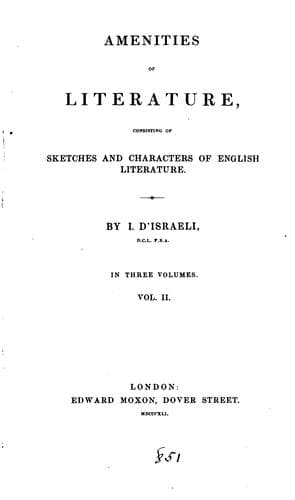
Amenities of Literature: Consisting of Sketches and Characters of English LiteratureDisraeli, Isaac
History
Amenities of Literature: Consisting of Sketches and Characters of English Literature
Disraeli, Isaac
Authors, English -- Biography; English literature -- History and criticism; Great Britain -- Intellectual life
The introduction of _preaching_ appears to have been followed by an
unhappy effect. Latimer, in the rude simplicity of his style, complains
of some that went to church for the benefit of being "lulled into a
nap." There was a still greater grievance in this novel custom of
preaching; for from the pulpits the turbulent were rousing the passions
of the people, by declaiming against what some termed "the abuses which
ought to be put away;" while others, persevering in their old doctrine,
were alarming their auditors, for the loss of what had been put away.
Pulpit thundered against pulpit; for it was not only the reformer, but
the anti-reformer, who were the preachers. The fact was, that by an
avaricious policy, "the court of augmentation," which had to pension the
monks of the suppressed houses, filled up the vacant benefices as fast
as they occurred, by appointing these annuitants, to curtail the
pension-list. The enemy was thus settled in the camp of the reformers.
This spirit of division was caught by the rude stage of that day in
their comedies or interludes. This inundation of popular clamour was
only to be stayed by coercion--by proclamations and orders in council.
The Council of State issued their orders, or rather their instructions,
how the preachers were to preach, and that none but the licensed should
be permitted to ascend into the pulpit. Even Latimer himself was
discountenanced for his apostolical freedoms, by inveighing against the
gentry, who sent their sons to college, instead of educating them at
home for the church. Academical degrees were abrogated as
anti-Christian; Greek was heresy; and all human learning was to be vain
and useless to "the gospellers." As the preachers were to be licensed,
it came to the turn of the players and the printers not to enact or
print their interludes, without a special licence from the privy
council; and at length the interludes were actually inhibited for
"containing matter relating to sedition;" and this proclamation more
particularly specifies those that "play in English." The Romanists had
their interludes as well as the Reformers. Bishop Percy once observed
that the excellence of the drama, as every wise man would have it, is
to form a supplement to the pulpit,--this literally occurred in the
present instance; but the pulpit was itself as disorderly, to use the
words of the proclamation, "as any light and fantastical head could list
to invent and devise." Our most skilful delver into dramatic history,
amidst his curious masses of disinterments, has brought up this
proclamation. We must connect the state of these rude players with these
rude preachers; the interludes were nothing more than reflections from
the sermons; player and preacher were the same. By connecting these
together, we form a juster notion of their purpose than we find in the
isolated fact. There was now sedition in religion as well as in
politics.
Public-domain text, read in full here on John Shaqi.
Reviews
Reviews
No reviews yet
Be the first to share your thoughts on this work.
Elsewhere in the archive
Join the Discussion
Join the discussion
Sign in to leave a comment or review.
Sign InorCreate an account