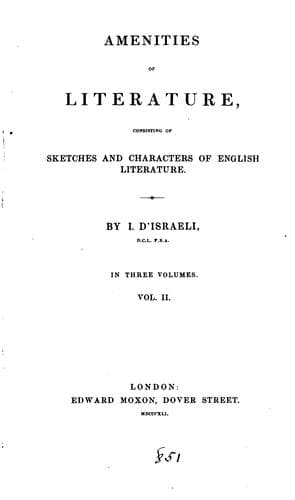
Amenities of Literature: Consisting of Sketches and Characters of English LiteratureDisraeli, Isaac
History
Amenities of Literature: Consisting of Sketches and Characters of English Literature
Disraeli, Isaac
Authors, English -- Biography; English literature -- History and criticism; Great Britain -- Intellectual life
The prevalent fervour scattered its sparks through all the ranks of
society, and the thoughts of all were concentrated on the sole object of
"the new religion." The Reformation was the great political topic in the
court of Edward the Sixth; discussions in theology were no longer
confined to colleges or to the clergy. Our poets, ever creatures of
their age, reflecting its temper, and who best tell its story, confined
their genius to ballads and interludes, making rough sport for loungers
and for the common people; or, in their quieter moods, were devoted to
metrical versions from the Scriptures. In a history of our vernacular
literature, the introduction of a versified psalter and of psalm-singing
forms an incident; as the passion for psalmody itself is a portion of
the history of the Reformation. "This infectious frenzy of sacred song,"
as Thomas Warton describes what he condemns as puritanic, we adopted
from the practice of Calvin, who had introduced psalm-singing into the
Geneva discipline, but really had himself borrowed it from the
popularity of the first psalms in French metre, by Clement Marot. This
natural and fine genius, as a commutation for an irregular life--and he
had been imprisoned for eating flesh in Lent--was persuaded by the
learned Vatable, the Hebrew Professor, to perform this signal act of
penance. The gay novelty charmed the court, and was equally delightful
to the people; every one chose the psalm which expressed his own
personal feelings or described his own condition, adapted to some
favourite air for the instrument or the voice. At the time it could have
been little suspected that while Calvin was stripping the religious
service of its pageantry, and denuding it even of its decent ceremonies,
he would have condescended to anything so human as a tune and a chorus;
yet the austere reformer of Geneva showed no deficient knowledge of
human nature, when he contrived to make men sing in concert, or carol in
the streets, and shorten their work by a song cheerful or sad; for
psalms there are for joy or for affliction, effusions for all hours,
suitable to all ranks.[2]
Public-domain text, read in full here on John Shaqi.
Reviews
Reviews
No reviews yet
Be the first to share your thoughts on this work.
Elsewhere in the archive
Join the Discussion
Join the discussion
Sign in to leave a comment or review.
Sign InorCreate an account