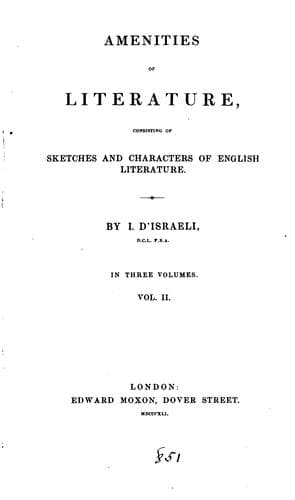
Amenities of Literature: Consisting of Sketches and Characters of English LiteratureDisraeli, Isaac
History
Amenities of Literature: Consisting of Sketches and Characters of English Literature
Disraeli, Isaac
Authors, English -- Biography; English literature -- History and criticism; Great Britain -- Intellectual life
As a printer and book-vendor, Crowley is distinguished by that curiosity
of research which led him to be the first publisher of "The Visions of
Piers Ploughman," which had hitherto slept in the dust of its manuscript
state. Warton restricts the merit of his discovery merely to the fervour
of a controversialist eager to propagate his own opinions; and truly the
bold spirit of reform, and the satirical strokes on the ecclesiastics of
the times of Edward the Third, in that remarkable and unknown author,
were in unison with a Reformer in the age of Reformation. It must be
confessed that the historian of our poetry cherished some collegiate
prejudices, and that his native good humour is liable to change when his
pen scourges a puritan and a predestinarian, as was Robert Crowley. But
Warton wrote when he imagined that the suppressed absurdities of Popery
required no longer any strong satire from a Calvinist; and as Crowley,
too, lived to hold many dignities in the reign of Elizabeth, Crowley
appeared to Warton to be the member of "a Church whose doctrines and
polity his undiscerning zeal had a tendency to destroy." Strype has only
ventured to describe Crowley as "an earnest professor of religion." The
meek curate of Low-Leyton could not rise to the magisterial indignation
of one of the "heads of houses," one who, at least, ought to have been,
and who, I understand, probably missed the honour and the profit by his
own ingenuous carelessness.
One of the most striking productions of this earnest Reformer, for its
freedom, was his address to the assembled Parliament. The title is
expressive--"An Information and Petition against the _Oppressors of the
Commoners of this Realm_. Compiled and imprinted for this only purpose,
that among them that have to do in the Parliament, some godly-minded
men may hereat take occasion to speak more in the matter than the author
was able to write." Crowley too modestly alludes to any deficiencies of
his own; his "information" is ample, and doubtless conveyed to the ear
of those "who had to do in the Parliament," what must have startled the
oldest senator.
Who are "the oppressors of the poor commoners?" All the orders in
society! the clergy--the laity--and, above all, "the Possessioners!"
Public-domain text, read in full here on John Shaqi.
Reviews
Reviews
No reviews yet
Be the first to share your thoughts on this work.
Elsewhere in the archive
Join the Discussion
Join the discussion
Sign in to leave a comment or review.
Sign InorCreate an account