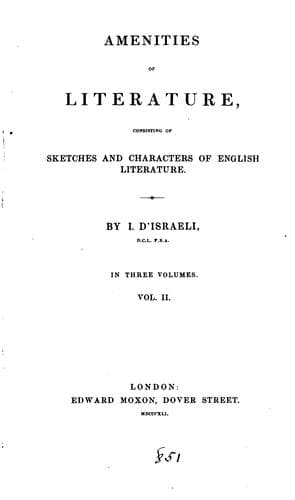
Amenities of Literature: Consisting of Sketches and Characters of English LiteratureDisraeli, Isaac
History
Amenities of Literature: Consisting of Sketches and Characters of English Literature
Disraeli, Isaac
Authors, English -- Biography; English literature -- History and criticism; Great Britain -- Intellectual life
Crowley had been a student at Magdalen College at Oxford, and obtained a
fellowship. At the close of the reign of Henry the Eighth, Crowley
appears to have sojourned in "the great city;" and in that of Edward the
Sixth, we must not be surprised to discover the Fellow of Magdalen
established as a printer and bookseller, and moreover combining the
elevated characters of poet and preacher. How it happened that a man of
letters, and not undistinguished by his genius, adopted a mechanical
profession, we may account for from the exigencies of the time. Possibly
Crowley's fellowship was what Swift once called "a beggarly fettleship."
In the hurried reform of the day, "the universal good" was attended by
"a great partial evil." In the dissolution of the abbeys and priories
they had also demolished those useful exhibitions proceeding from them,
by which poor students were maintained at the universities. Many, thus
deprived of the means of existence at college, were compelled to forsake
their Alma-Mater and seek another course of life. It was probably this
incident which had thrown this learned man among the people. How Crowley
contrived to fulfil his fourfold office of printer, bookseller, poet,
and preacher, with eminent success, the scanty notices of his life
disappoint our curiosity. We would gladly enter into the recesses of
this man's arduous life. Did he partition the hours of his day? What
habits harmonised such clashing pursuits? Was he a sage whose wisdom
none of his followers have gathered? Was the shop of the studious man
haunted by learned customers? When we think of the printer's press and
the bookseller's counter, we are disposed to inquire, Where mused the
poet, and where stood the preacher?
Crowley is the author of many controversial pieces, and some satirical
poems reflecting the manners and the passions of his day, all which
enjoyed repeated editions. But he was not less a favourite sermoniser.
He touched a tremulous chord in the hearts of the people, and his
opinions found an echo in their breasts. The pulpit and the press,
perhaps, had been his voluntary choice, to print out what he had spoken
ere it perished, or offer a supplement to a sermon in some awful tome of
theology and reform. His Pulpit and his Press!--"those two prolific
sources of faction," exclaimed Thomas Warton.
Public-domain text, read in full here on John Shaqi.
Reviews
Reviews
No reviews yet
Be the first to share your thoughts on this work.
Elsewhere in the archive
Join the Discussion
Join the discussion
Sign in to leave a comment or review.
Sign InorCreate an account