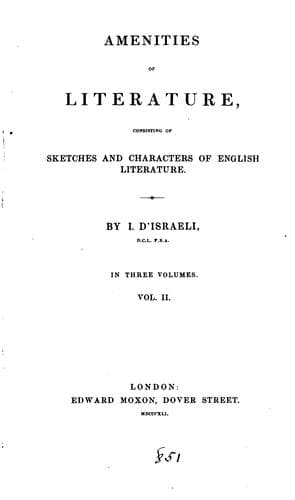
Amenities of Literature: Consisting of Sketches and Characters of English LiteratureDisraeli, Isaac
History
Amenities of Literature: Consisting of Sketches and Characters of English Literature
Disraeli, Isaac
Authors, English -- Biography; English literature -- History and criticism; Great Britain -- Intellectual life
The heads of houses stood for antiquity, with all its sacred rust of
time; they looked on reform with a suspicious eye, while every man in
his place marked his eager ejector on the watch. Under Edward the Sixth,
Dr. Richard Smith, a potent scholastic, stood forth the stern advocate
of the ancient order of things. However, to preserve his professorship,
this doctor recanted of "his popish errors;" shortly afterwards he
declared that it was no recantation, but a retractation signifying
nothing: to make the doctor somewhat more intelligible, and a rumour
spreading that "Dr. Smith was treading in his old steps," he was again
enforced to read his recantation, with an acknowledgment that "his
distinction was frivolous, both terms signifying the same thing." He did
not recant the professorship till Cranmer invited Peter Martyr from
Germany to the chair of the disguised Romanist. The political Jesuit
attended even the lectures of his obtrusive rival, took notes with a
fair countenance, till suddenly burst the latent explosion. An armed
party menaced the life of Peter Martyr, and a theological challenge was
sent from the late professor to hold a disputation on "the real
presence." Peter Martyr protested against the barbarous and ambiguous
terms of the scholastic logic, and would only consent to explain the
mystery of the sacrament by the terms of _carnaliter_ and
_corporaliter_; for the Scriptures, in describing the Supper, mention
the flesh and the body, not the matter and substance. He would, however,
indulge them to accept the terms of _realiter_ and _substantialiter_.
There was "a great hubbub" at Oxford on this most eventful issue. The
popish party and the reformers were alike hurried and busied; books and
arguments were heaped together; the meanest citizen took his stand. The
reforming visitors of Edward arrived; all met, all but Dr. Smith, who
had flown to Scotland, on his way to Louvain. However, he had left his
able deputies, who were deep in the lore in which it appears Peter
Martyr required frequent aid to get on. Both the adverse parties
triumphed; that is usual in these logomachies; but the Romanists account
for the success of the Reformed by the circumstance that their judges
were Reformers.
Public-domain text, read in full here on John Shaqi.
Reviews
Reviews
No reviews yet
Be the first to share your thoughts on this work.
Elsewhere in the archive
Join the Discussion
Join the discussion
Sign in to leave a comment or review.
Sign InorCreate an account