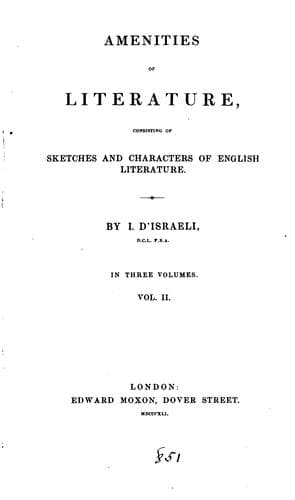
Amenities of Literature: Consisting of Sketches and Characters of English LiteratureDisraeli, Isaac
History
Amenities of Literature: Consisting of Sketches and Characters of English Literature
Disraeli, Isaac
Authors, English -- Biography; English literature -- History and criticism; Great Britain -- Intellectual life
Such abstruse subjects connected with religious associations, and
maintained or refuted by the triumph or the levity of some haughty
polemic, produced the most irreverent feelings among the vulgar. As the
Reformation was then to be predominant, the common talk of the populace
was diversified by rhymes and ballads; and it was held, at least by the
wits, that there was "no real presence," since Dr. Smith had not dared
to show himself. The papistical sacrament was familiarly called "Jack in
the Box," "Worm's meat," and other ludicrous terms, one of which has
descended to us in the term which jugglers use of _hocus pocus_. This
familiar phrase, Anthony Wood informs us, originated in derision of the
words, "Hoc est corpus," slovenly pronounced by the mumbling priest in
delivering the emblem as a reality. As opprobrious words with the
populace indicate their furious acts, scandalous scenes soon followed.
The censers were snatched from the hands of the officiating priests;
mass-books were flung at their heads; all red-lettered and illuminated
volumes were chopped in pieces by hatchets: nor was this done always by
the populace, but by students, who in their youth and their reform knew
of no better means to testify their new loyalty to the visitors of
Edward. One of the more ludicrous scenes among so many shameful ones,
was a funereal exhibition of the schoolmen. Peter Lombard, "the master
of sentences," accompanied by Duns Scotus and Thomas Aquinas, carried on
biers, were tumbled into bonfires!
Five years after these memorable scenes, the same drama was to be
repeated, performed by a different company of actors. Religion assumed a
new face; that which had hardly been established was blasted by the name
of heresy. All who had flourished under Edward were now called in
question. The ancient tenants now ejected the newcomers, and affronted
them by the same means they had themselves been affronted. No one at
first knew how affairs were to turn out; some still clung to the reform;
others were reverting to the old system. There were in fact for some
time two religions at once in the university. The Common Prayer-book in
English was, however, but faintly read, while the Mass was loudly
chanted. Jewel's letter to the Queen was cautiously worded. This zealous
reformer, in an unhappy moment, had yielded to his fears, and subscribed
a recantation, which he soon after abjured before a Protestant
congregation in Germany. When Peter Martyr heard the little bell ring to
Mass, he sighed, and said, "that bell would destroy all the sound
doctrine in the college." Gardiner gave him a safe-conduct homewards,
which saved Peter Martyr from the insolent triumph of his rival, the
scholastic Dr. Smith, and the Spanish friars with whom Mary supplied his
place.
But the Marians also burned books, as likewise men!
Public-domain text, read in full here on John Shaqi.
Reviews
Reviews
No reviews yet
Be the first to share your thoughts on this work.
Elsewhere in the archive
Join the Discussion
Join the discussion
Sign in to leave a comment or review.
Sign InorCreate an account