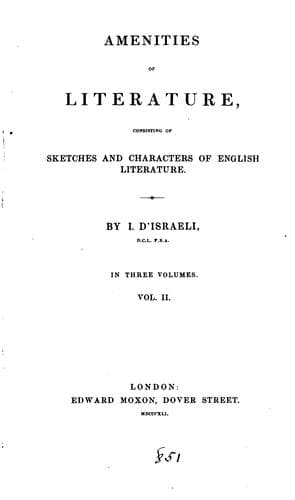
Amenities of Literature: Consisting of Sketches and Characters of English LiteratureDisraeli, Isaac
History
Amenities of Literature: Consisting of Sketches and Characters of English Literature
Disraeli, Isaac
Authors, English -- Biography; English literature -- History and criticism; Great Britain -- Intellectual life
It has been conjectured that they were first introduced into Italy, from
its intercourse with the metropolis of the Greek Empire; but when we
have recourse to its literary recorder, we gather nothing but ambiguity.
Tiraboschi is dubious whether the early Italian mysteries exhibited in
the year 1264 were anything more than a dumb show, or the processional
display of a religious pageant. Decided, on system, not to approve of
such familiar exhibitions of sacred themes, the Jesuit has cautiously
noticed two companies who evidently had performed a mystery, or
miracle-play. In that piece there is a direction that "An angel and the
virgin _sing_;" but our learned Jesuit will not venture even to surmise
that "the virgin and the angel" _acted_ their parts, but merely chanted
a poem.[3] The literary antiquary Signorelli inclines to fix the
uncertain date of the first sacred drama so late as in 1445.[4] In
France these early scriptural exhibitions were so little comprehended,
that Le Grand D'Aussy, in his pretension that his nation possessed the
drama in the thirteenth century, derives the origin of their mysteries
from such pieces as the three fabliaux which he has given, as the
earliest dramas.[5] So little conversant in his day--not a distant
one--were the French antiquaries with a subject which has of late become
familiar to their tastes. We learn nothing positive of their "Mysteries"
till their "Confraerie de la Passion" was incorporated in 1402.
The earliest of these representations necessarily would be in Latin,[6]
and performed in monasteries by the ecclesiastics themselves, on
festival days; in this state, how could they have been designed for the
people? Aware of this difficulty, and convinced that these holy plays
were in their origin intended for popular instruction and recreation, it
has been conjectured that the Latin mystery was accompanied by a
pantomimic show, for the benefit of the people; but an impatient
concourse could be little affected by the action of the performers,
almost as incomprehensible as the language was unintelligible. The
people, a great animal only to be fondled in one way, as usual, worked
out their own wants; they taught learned clerks the only method by which
they were to be amused, by having the same thing after their own
fashion, and to be comprehended in their own language; and the day at
last arrived when even the people themselves would be actors. In the
obscurity of the medieval period, the literary antiquary has often to
feel his way in the darkness, till among uncertain things he fancies
that he grasps the palpable. We are not furnished with precise dates,
but some natural circumstances may account for the introduction of the
mysteries in the _vernacular idiom_. About the eighth century, merchants
carried on their trades in the great fairs, and to attract the people
together, jugglers, minstrels, and buffoons were well paid, and the
populace flocked. Such a multitudinous concourse appears to have created
Public-domain text, read in full here on John Shaqi.
Reviews
Reviews
No reviews yet
Be the first to share your thoughts on this work.
Elsewhere in the archive
Join the Discussion
Join the discussion
Sign in to leave a comment or review.
Sign InorCreate an account