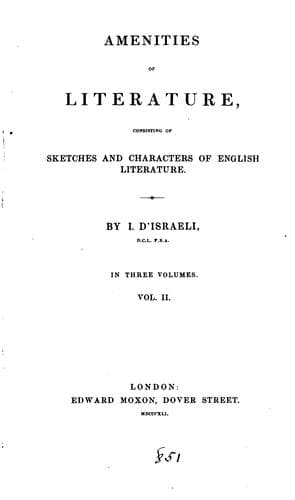
Amenities of Literature: Consisting of Sketches and Characters of English LiteratureDisraeli, Isaac
History
Amenities of Literature: Consisting of Sketches and Characters of English Literature
Disraeli, Isaac
Authors, English -- Biography; English literature -- History and criticism; Great Britain -- Intellectual life
alarm among their great lords; and the ecclesiastics in vain proscribed
these licentious revelries. It would be nothing more than a stroke of
their accustomed policy if we imagine that, seeing the people were eager
after such public entertainments, the monks should take them into their
own hands; and offering a far more imposing exhibition than even the
tricks of jugglers, combining piety with merriment, at once awe and
delight the people by their scriptural histories and the legends of
saints, in the language common to them all, thus enticing them from
profane mummeries. It was a revolution in the history of the people,
who, without education, seemed to grow learned in the mysteries and to
be witnesses of miracles!
This account is not incongruous with another probably not less true, and
which indeed has been received as indisputable among the more ancient
literary historians of France, and is well known by the verses of
Boileau in his "Art of Poetry." Palmers and Pilgrims--the one returning
from the East, bearing in their caps the hallowed palm-branch of
Palestine, and the other from some distant shrine, their chaplets and
cloaks covered with the many-coloured scallops--taking their stand in
thoroughfares, and leaning on their staffs, while their pendent relics
and images attracted the gazer, would win an audience from among the
people. These venerable itinerants or semi-saints recited their sacred
narratives in verse or even in prose; they had sojourned amid "the holy
places," which they described; they had their adventures to tell,
serious or comic; and that many of these have entered into the great
body of ROMANCE, and were caught up by the Trouvères, we can easily
imagine. These strollers excited the piety and contributed to the
amusement of their simple auditors, who, in the course of time,
occasionally provided for these actors a stage on a green in the
vicinage of their town; thus an audience of burghers and clowns, and no
critics, was first formed. The ecclesiastics adopted performances so
certain of popular attraction, and became the sole authors of these
inartificial dramas, as they were of romances and chronicles. They had
but one object, and knew to treat it only in one way. They imagined that
they were instructing the people by initiating them into scriptural
history, the only history then known, and by keeping the sources of
popular recreation in their own hands, they looked for their success in
the degree they excited their terror or their piety, and not less their
ribald merriment; and for the people the profane drollery and the
familiar dialogue were as consistent with their feelings as the articles
of their creed, for which they would have died, as well as laughed at.
Public-domain text, read in full here on John Shaqi.
Reviews
Reviews
No reviews yet
Be the first to share your thoughts on this work.
Elsewhere in the archive
Join the Discussion
Join the discussion
Sign in to leave a comment or review.
Sign InorCreate an account