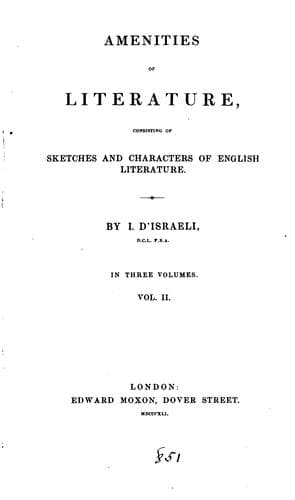
Amenities of Literature: Consisting of Sketches and Characters of English LiteratureDisraeli, Isaac
History
Amenities of Literature: Consisting of Sketches and Characters of English Literature
Disraeli, Isaac
Authors, English -- Biography; English literature -- History and criticism; Great Britain -- Intellectual life
These unsubstantial personages of allegory--these apparitions of human
nature--were to assume a more bodily shape, when not only the passions,
but the individual characters whom they agitated, were exhibited in
every-day life, not however yet venturing into a wide field of society,
but peeping from a corner,--it was nothing more than a single act,
satirical and comic, in a dialogue sustained by three or four
professional characters of the times. It was called the INTERLUDE, or
"_a play between_," to zest by its pleasantry the intervals of a
luxurious, and sometimes a wearisome, banquet. The most dramatic
interludes were the invention of JOHN HEYWOOD, the jester of Henry the
Eighth. The Scottish Bard, Douglas, the Bishop of Dunkeld, alludes to
these interludes, in his "Paleys of Honour."
Grete was the preis the feast royál to sene,
At ease they eat, with INTERLUDES between.[17]
Such was the march of events, the steppings which were conducting the
national genius to the verge of tragedy and comedy; a vast interval of
time and labour separates the writers of these primitive plays from the
fathers of dramatic art; yet however ludicrous to us the simplicity of
the age, often these singular productions betray shrewd humour and
natural emotions. To condemn them as barbarous and absurd would be
forming a very inadequate notion of the influence of these earliest of
our European dramas on their contemporaries. An enlightened lover of the
arts has said, perhaps with great truth, that Raphael never received
from his age such flattering applause, and excited such universal
approbation, as did Cimabué, the rude father of his art. The first
essays strike more deeply than even the masterpieces of a subsequent age
after all its successful labour; for its more finished excellence
depends partly on reflection, as well as on sensation.
The mystery and the morality lingered among us; but in the improved
taste and literature of the court of Henry the Eighth, the facetious
INTERLUDE, while it was facetious, won the royal smile. The successive
agitations of the age, however, could not fail to reflect its tempers in
these public exhibitions. In the reforming government of Edward the
Sixth, the miracle-plays were looked on as Romish spectacles, and were
fast sinking into neglect, when the clergy of the papistic queen
retrograded into this whole fabulous mythology; adepts not only in the
craft of miracles, but desirous, by these shows or "plays of miracles,"
to revive the taste in the imaginations of the people. The public
authorities patronised what recently they had laughed at or had scorned.
On Corpus Christi day, the Lord Mayor and the Privy Council were
spectators of _The Passion of Christ_, always an affecting drama; and it
was again represented before this select audience: and on St. Olave's
day, the truly "miracle-play" of that legendary saint was enacted in the
church dedicated to the saint.[18]
Public-domain text, read in full here on John Shaqi.
Reviews
Reviews
No reviews yet
Be the first to share your thoughts on this work.
Elsewhere in the archive
Join the Discussion
Join the discussion
Sign in to leave a comment or review.
Sign InorCreate an account