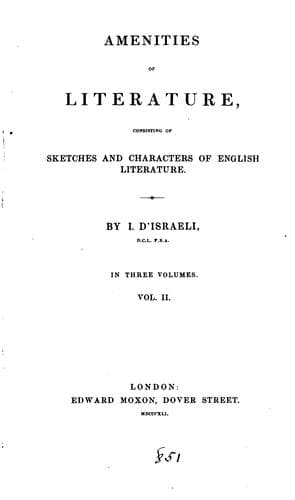
Amenities of Literature: Consisting of Sketches and Characters of English LiteratureDisraeli, Isaac
History
Amenities of Literature: Consisting of Sketches and Characters of English Literature
Disraeli, Isaac
Authors, English -- Biography; English literature -- History and criticism; Great Britain -- Intellectual life
The history of the INTERLUDE more particularly marks an epoch, for it
enters into our political history. Mysteries and moralities were purely
religious or ethical themes, but the comic interludes took a more
adventurous course; and their writers, accommodating themselves to the
fashions of the day, were the organs of the prevalent factions then
dividing the unquiet realm.
From the earliest moment of the projected reformation or emancipation
from the Papal dominion by Henry, we discover the players of interludes
at their insidious work; but affairs were floating in that uncertain
state when the new had by no means displaced the old. In 1527, Henry the
Eighth was greatly diverted at an interlude where the heretic Luther and
his wife were brought on the stage, and the Reformers were
ridiculed.[19] The king in the Creed and the ceremonies remained a
Romanist; and in 1533, a proclamation inhibits "the playing of
enterludes concerning doctrines now in question and controversy."[20]
"The Defender of the Faith" was still irresolute to defend or to attack.
In 1543, an act of parliament was passed for the control of dramatic
representations; and at this later date, this reforming monarch decreed,
that "no person should play in interludes any matter contrary to the
doctrines of the Church of Rome!" Chronology in history is not only
useful to date events, but to date the passions of sovereigns. It was
absolutely necessary for Edward the Sixth on his ascension immediately
to repeal this express act of parliament of his father;[21] and then the
emancipated interluders now, openly, with grave logic or laughing
ridicule, struck at all "the Roman superstitions." Hence we had Catholic
and Protestant dramas. The Romanists had made very free strictures on
Cromwell, Cranmer, and their followers; and on the side of the reformed
we have no deficiency of oppugners of the Romish Church. Under Henry the
Eighth, we have the sacred drama of _Every-man_, a single personage, by
whom the writer not unaptly personifies human nature. This drama came
from the Romanists to recall the auditors back to the forsaken
ceremonies and shaken creed of their fathers. Under Edward the Sixth, we
have _Lusty Juventus_, whom Satan and his old son Hypocrisy, with an
extraordinary nomenclature of "holy things," would inveigle back to that
seductive harlot, "Abominable Living," which the Reformer imagined was
the favourite Dulcinea of "the false priests."[22] On the accession of
Mary, this queen hastened a proclamation against the interludes of the
Reformers. The term used in the proclamation looks like an ironical
allusion to a word which now had long been bandied on the lips of the
populace. It specifies to be for "the _reformation_ of busy meddlers in
matters of religion." A strict watch was kept on the players, some of
whom suffered for enacting a reformed interlude. Such plays seem to have
been patronised in domestic secrecy. The interference of the Star
Public-domain text, read in full here on John Shaqi.
Reviews
Reviews
No reviews yet
Be the first to share your thoughts on this work.
Elsewhere in the archive
Join the Discussion
Join the discussion
Sign in to leave a comment or review.
Sign InorCreate an account