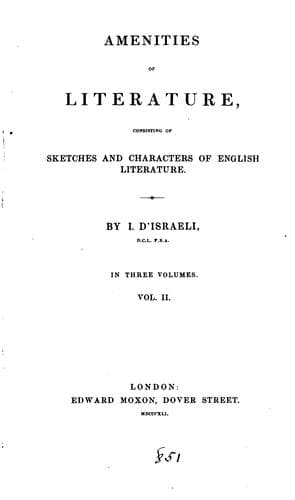
Amenities of Literature: Consisting of Sketches and Characters of English LiteratureDisraeli, Isaac
History
Amenities of Literature: Consisting of Sketches and Characters of English Literature
Disraeli, Isaac
Authors, English -- Biography; English literature -- History and criticism; Great Britain -- Intellectual life
Chamber was called forth in 1556 for the total suppression of dramatic
entertainments. In many places some magistrates had slackened their
pursuit after "players," and reluctantly obeyed the public authorities.
The first act of Elizabeth resembled in its character those of her
brother Edward and her sister Mary, however opposite were the systems of
their governments. The queen put a sudden stop to the enacting of all
interludes which opposed the progress of the Reformation; there seemed
to be no objection to any of a different cast; but Elizabeth lived to be
an auditor of more passionate dramas than these theological logomachies
performed on the stage, where the dull poet had sometimes quoted chapter
and verse in Genesis or St. Matthew.
It is not generally known that, while these Catholic and Protestant
dramas were opposed to each other in England, at the same period the
Huguenots in France had also entertained the derisory muse of the more
comic interludes. There was, however, this difference in the fortunes of
the writers; as in France the government had never reformed nor changed
their position, there could have been no period which admitted of the
public representation of these satirical dramas. In their dramatic
history, it was long considered that the subjects of these Hugonistic
dramas were too tender to bear the handling; and the brothers Parfait,
in their copious "History of the French Theatre," only afford a slight
indication of "the turbulent Calvinists," who had spread "pieces of
dangerous heresy and fanaticism against the Pope, the cardinals, and the
bishops; works which could not be noticed without profaning the
page!"--and therefore they refrain from giving even their titles! It is
in this spirit, and with such apologies, that historians have often
castrated their own history. The existence of these dramas might have
escaped our knowledge, had not the more enlightened judgment of the Duke
de la Vallière supplied what the more stubborn Romanists had suppressed.
This lover of literature has favoured the curious with the interesting
analysis of two rare French Protestant plays, _Le Marchand Converti_, in
1558; and _Le Pape Malade et tirant à sa Fin_, in 1561. Allowing largely
for the gross invectives of the Calvinist--"_les impiétés_"--they
display an original comic invention, and sparkle with the most lively
sallies.[23] It is remarkable that _Le Marchand Converti_, at such an
early period of modern literature, is a regular comedy of five acts,
introduced by a prologue in verse; odes are interspersed, and each act
concludes with a chorus, whom the author calls "the company." The
classical form of this unacted play, instinct with the spirit of the new
reform, betrays the work of a learned hand.
FOOTNOTES:
Public-domain text, read in full here on John Shaqi.
Reviews
Reviews
No reviews yet
Be the first to share your thoughts on this work.
Elsewhere in the archive
Join the Discussion
Join the discussion
Sign in to leave a comment or review.
Sign InorCreate an account