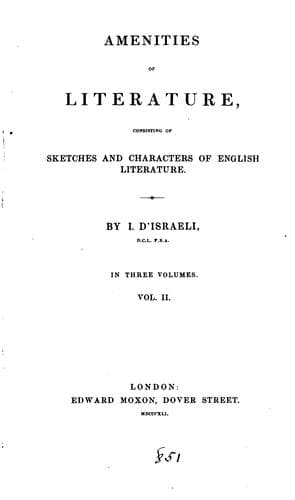
Amenities of Literature: Consisting of Sketches and Characters of English LiteratureDisraeli, Isaac
History
Amenities of Literature: Consisting of Sketches and Characters of English Literature
Disraeli, Isaac
Authors, English -- Biography; English literature -- History and criticism; Great Britain -- Intellectual life
BALE was originally educated in a monastery; he found an early patron,
and professed the principles of the Reformation; and, like Luther,
sealed his emancipation from Catholic celibacy by a wife, whom he
tenderly describes as "his faithful Dorothea." It was a great thing for
a monk to be mated with such constancy at a time when women were usually
to be described as shrews, or worse. From the day of marriage the malice
of persecution haunted the hapless heretic; such personal hatreds could
not fail of being mutual. He seems to have too hastily anticipated the
Reformation under Henry the Eighth, for though that monarch had freed
himself from "the bishop of Rome," he had by no means put aside the
doctrines, and Bale, who had already begun a series of two-and-twenty
reforming interludes in his "maternal idiom," found it advisable to
leave a kingdom but half reformed. He paused not, however, till he had
written a whole library against "the Papelins," the last production
always seemed the most envenomed. On the death of Henry he unexpectedly
appeared before Edward the Sixth, who imagined that he had died. Bale
had the misfortune to be promoted to the Irish bishopric of Ossory--to
plant Protestantism in a land of Papistry! Frustrated in his unceasing
fervour, Bale escaped from martyrdom by hiding himself in Dublin. The
death of Edward relieved our Protestant bishop from this sad dilemma;
for on the accession of Mary he flew into Switzerland. There he
indulged his anti-papistical vein; the press sent forth a brood, among
which might have been some of better growth, for he laboured on our
British biography and literature; but as there were yet but few
Protestants to record, it flowed, and sometimes overflowed, against all
the friends of the Papacy; Pits, who subsequently resumed the task, a
sullen and fierce Papist, in revenge omitted in the line of our
illustrious Britons, Wickliffe and every Wickliffite. Such were the
beginnings of our literary history. On the accession of Elizabeth, his
country received back its exile; but Bale refused to be reinstated in
his Irish see, and sunk into a quiet prebendary of Canterbury. Fuller
has called our good bishop "Bilious Bale." Some conceive that this
bishop has suffered ill-treatment merely for having thrown out some
remarkable, or abominable, invectives. Proselytes, however sincere in
their new convictions and their old hatreds, both operating at once,
colour their style as some do their faces, till by long use the
heightened tint seems faint, and they go on deepening it, and thus at
last the natural countenance is lost in the artificial mass.
If Bale were no poet, in the singular dramas we have, he at least
displays a fluent invention; he tells plainly what is meant, which we
like to learn; and I do not know whether it be owing to his generally
indifferent verse that we sometimes are struck by an idiomatic phrase,
and a richness of rhymes peculiar to himself, which sustain our
attention.[1]
Public-domain text, read in full here on John Shaqi.
Reviews
Reviews
No reviews yet
Be the first to share your thoughts on this work.
Elsewhere in the archive
Join the Discussion
Join the discussion
Sign in to leave a comment or review.
Sign InorCreate an account