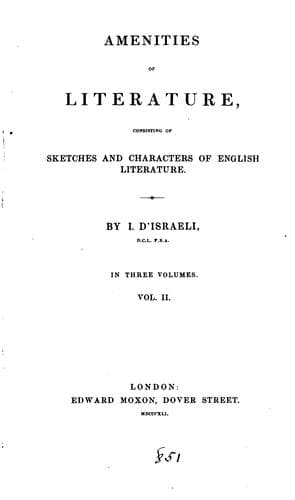
Amenities of Literature: Consisting of Sketches and Characters of English LiteratureDisraeli, Isaac
History
Amenities of Literature: Consisting of Sketches and Characters of English Literature
Disraeli, Isaac
Authors, English -- Biography; English literature -- History and criticism; Great Britain -- Intellectual life
Of JOHN HEYWOOD, the favourite jester of Henry the Eighth and his
daughter Mary, and the intimate of Sir Thomas More, whose congenial
humour may have mingled with his own, more table-talk and promptness at
reply have been handed down to us than of any writer of the times. His
quips, and quirks, and quibbles are of his age, but his copious
pleasantry still enlivens; these smoothed the brow of Henry, and relaxed
the rigid muscles of the melancholy Mary. He had the _entrée_ at all
times to the privy-chamber, and often to administer a strong dose of
himself, which her majesty's physicians would prescribe. He is
distinguished as Heywood the epigrammatist; a title fairly won by the
man who has left six centuries of epigrams, collected and adjusted as
many English proverbs in his verse, besides the quaint conceits of
"crossing of proverbs."[2] Of these six hundred epigrams it is possible
not a single one is epigrammatic: we have never had a Martial. Even when
it became a fashion, to write books of epigrams half a century
subsequently, they usually closed in a miserable quibble, a dull
apophthegm, or at the best, like those of Sir John Harrington, in a
plain story rhymed. Wit, in our sense of the term, was long unpractised,
and the modern epigram was not yet discovered.
Heywood, who had flourished under Henry, on the change in the reign of
Edward, clung to the ancient customs. He was a Romanist, but had he not
recovered in some degree from the cecity of superstition, he had not so
keenly exposed, as he has done, some vulgar impostures. It happened,
however, that some unlucky jest, trenching on treason, flew from the
lips of the unguarded jester; it would have hanged some--but pleasant
verses promptly addressed to the young sovereign saved him at the
pinch,--however, he gathered from "the council" that this was no
jesting-time, and he left the country in the day that Bale was returning
from his emigration under King Henry. On Mary's accession, Bale again
retired, and Heywood suddenly appeared at court. Asked by the queen
"What wind blew him there?" "Two specially; the one to see your
majesty!" he replied. "We thank you for that," said the queen, "but I
pray you what is the other?" "That your grace might see me!" There was
shrewdness in this pleasantry, to bespeak the favour of his royal
patroness. Four short years did not elapse ere Elizabeth opened her long
reign, and then the merry Romanist for ever bid farewell to his native
land, while Bale finally sat beside his English hearth. These were very
moveable and removeable times, and no one was certain how long he should
remain in his now locality.
Public-domain text, read in full here on John Shaqi.
Reviews
Reviews
No reviews yet
Be the first to share your thoughts on this work.
Elsewhere in the archive
Join the Discussion
Join the discussion
Sign in to leave a comment or review.
Sign InorCreate an account