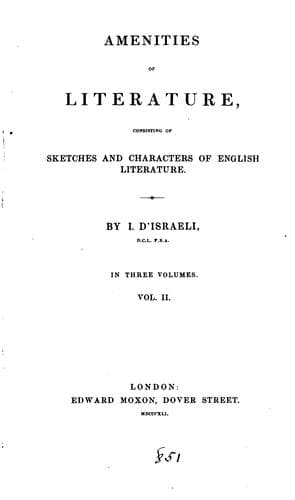
Amenities of Literature: Consisting of Sketches and Characters of English LiteratureDisraeli, Isaac
History
Amenities of Literature: Consisting of Sketches and Characters of English Literature
Disraeli, Isaac
Authors, English -- Biography; English literature -- History and criticism; Great Britain -- Intellectual life
It would, perhaps, have surprised ROGER ASCHAM, the scholar of a learned
age, and a Greek professor, that the history of English literature might
open with his name; for in his English writings he had formed no
premeditated work, designed for posterity as well as his own times. The
subjects he has written on were solely suggested by the occasion, and
incurred the slight of the cavillers of his day, who had not yet learned
that humble titles may conceal performances which exceed their promise,
and that trifles cease to be trivial in the workmanship of genius.
An apology for a favourite recreation, that of archery, for his
indulgence in which his enemies, and sometimes his friends, reproached
the truant of academic Greek; an account of the affairs of Germany while
employed as secretary to the English embassy; and the posthumous
treatise of "The Schoolmaster," originating in an accidental
conversation at table, constitute the whole of the claims of Ascham to
the rank of an English classic--a degree much higher than was attained
by the learning of Sir Thomas Elyot, and the genius of Sir Thomas More.
The mind of Ascham was stored with all the wealth of ancient literature
the nation possessed. Ascham was proud, when alluding to his master the
learned Cheke, and to his royal pupil Queen Elizabeth, of having been
the pupil of the greatest scholar, and the preceptor to the greatest
pupil in England; but we have rather to admire the intrepidity of his
genius, which induced him to avow the noble design of setting an example
of composing in our vernacular idiom. He tells us in his "Toxophilus,"
"I write this English matter in the English language for Englishmen." He
introduced an easy and natural style in English prose, instead of the
pedantry of the unformed taste of his day; and adopted, as he tells us,
the counsel of Aristotle, "to speak as the common people do, to think as
wise men do."
Public-domain text, read in full here on John Shaqi.
Reviews
Reviews
No reviews yet
Be the first to share your thoughts on this work.
Elsewhere in the archive
Join the Discussion
Join the discussion
Sign in to leave a comment or review.
Sign InorCreate an account