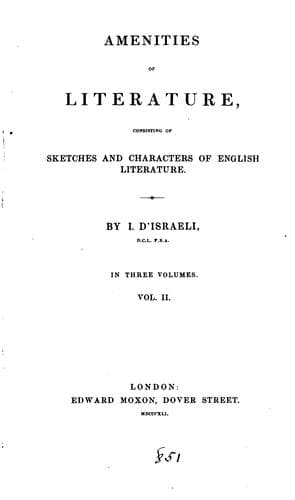
Amenities of Literature: Consisting of Sketches and Characters of English LiteratureDisraeli, Isaac
History
Amenities of Literature: Consisting of Sketches and Characters of English Literature
Disraeli, Isaac
Authors, English -- Biography; English literature -- History and criticism; Great Britain -- Intellectual life
The study of Greek was the reigning pursuit in the days of Ascham. At
the dispersion of the Greeks on the loss of Constantinople, the learned
emigrants brought with them into Europe their great originals; and the
subsequent discovery of printing spread their editions. The study of
Greek, on its first appearance in Europe, alarmed the Latin Church, and
was long deemed a dangerous and heretical innovation. The cultivation of
this language was, however, carried on with enthusiasm, and a
controversy was kindled, even in this country, respecting the ancient
pronunciation. A passion for Hellenistic lore pervaded the higher
classes of society. There are fashions in the literary world as sudden
and as capricious as those of another kind; and which, when they have
rolled away, excite a smile, although possibly we have only adopted
another of fresher novelty. The Greek mania raged. Ascham informs us
that his royal pupil Elizabeth understood Greek better than the canons
of Windsor; and, doubtless, while the queen was translating Isocrates,
the ladies in waiting were parsing. Lady Jane Grey studying Plato was
hardly an uncommon accident; but the touching detail which she gave to
Ascham of her domestic persecution, on trivial forms of domestic life,
which had induced her to fly for refuge to her Greek, has thrown a deep
interest on that well-known incident. All educated persons then studied
Greek; when Ascham was secretary to our ambassador at the Court of
Charles the Fifth, five days in the week were occupied by the ambassador
reading with the secretary the Greek tragedians, commenting on
Herodotus, and reciting the Orations of Demosthenes. But this rage was
too capricious to last, and too useless to be profitable; for neither
the national taste nor the English language derived any permanent
advantage from this exclusive devotion to Greek, and the fashion became
lost in other studies.
It was a bold decision in a collegiate professor, who looked for his
fame from his lectures on Greek, to venture on modelling his native
idiom, with a purity and simplicity to which it was yet strange. Ascham,
indeed, was fain to apologise for having written in English, and offered
the king, Henry the Eighth, to make a Greek or a Latin version of his
"Toxophilus," if his grace chose. "To have written in another tongue
had been both more profitable for my study, and also more honest
[honourable] for my name; yet I can think my labour well bestowed, if,
with a little hindrance of my profit and name, may come any furtherance
to the pleasure or commodity of _the gentlemen and yeomen of England_.
As for the Latin and Greek tongue, everything is so excellently done in
them that none can do better; _in the English tongue_, contrary,
_everything in a manner so meanly, both for the matter and handling,
that no man can do worse_."
Public-domain text, read in full here on John Shaqi.
Reviews
Reviews
No reviews yet
Be the first to share your thoughts on this work.
Elsewhere in the archive
Join the Discussion
Join the discussion
Sign in to leave a comment or review.
Sign InorCreate an account