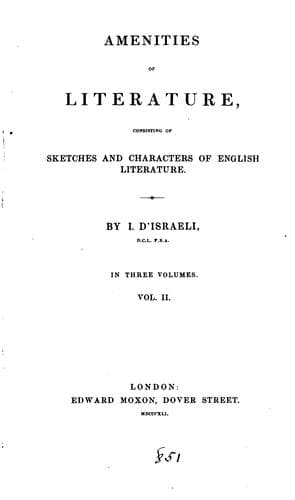
Amenities of Literature: Consisting of Sketches and Characters of English LiteratureDisraeli, Isaac
History
Amenities of Literature: Consisting of Sketches and Characters of English Literature
Disraeli, Isaac
Authors, English -- Biography; English literature -- History and criticism; Great Britain -- Intellectual life
Such were the first difficulties which the fathers of our native
literature had to overcome. Sir Thomas Elyot endured the sneer of the
cavillers, for his attempt to inlay our unpolished English with Latin
terms; and Roger Ascham, we see, found it necessary to apologise for at
all adopting the national idiom. Since that day neologisms have
fertilised the barrenness of our Saxon, and the finest geniuses in
Europe have abandoned the language of Cicero, to transfuse its grace
into an idiom whose penury was deemed too rude for the pen of the
scholar. Ascham followed his happier genius, and his name has created an
epoch in the literature of England.
A residence of three years in Germany in the station of confidential
secretary of our ambassador to the Emperor Charles the Fifth, placed him
in a more extensive field of observation, and brought him in contact
with some of the most remarkable men of his times. It is much to be
regretted, that the diary he kept has never been recovered. That Ascham
was inquisitive, and, moreover, a profound observer at an interesting
crisis in modern history, and that he held a constant intercourse with
great characters, and obtained much secret history both of persons and
of transactions, fully appears in his admirable "Report of the Affairs
and State of Germany, and the Emperor Charles' Court." This "Report" was
but a chance communication to a friend, though it is composed with great
care. Ascham has developed with a firm and masterly hand the complicated
intrigues of the various powers, when Charles the Fifth seemed to give
laws to Germany and Italy. This emperor was in peace with all the world
in 1550, and in less than two years after, he was compelled to fly from
Germany, surrounded by secret enemies. Ascham has traced the
discontents of the minor courts of Italian dukes, and German princes,
who gradually deserted the haughty autocrat--an event which finally led
to the emperor's resignation. It is a moral tale of princes openly
countenancing quietness, and "privily brewing debate"--a deep
catastrophe for the study of the political student. Ascham has explained
the double game of the court of Rome, under the ambitious and restless
Julius the Third, who, playing the emperor against the French monarch,
and the French monarch against the emperor, worked himself into that
intricate net of general misery, spun out of his own crafty
ambidexterity. This precious fragment of secret history might have
offered new views and many strokes of character to the modern historian,
Robertson, who seems never to have discovered this authentic document;
yet it lay at hand. So little even in Robertson's day did English
literature, in its obscurer sources, enter into the pursuits of our
greatest writers.
Public-domain text, read in full here on John Shaqi.
Reviews
Reviews
No reviews yet
Be the first to share your thoughts on this work.
Elsewhere in the archive
Join the Discussion
Join the discussion
Sign in to leave a comment or review.
Sign InorCreate an account