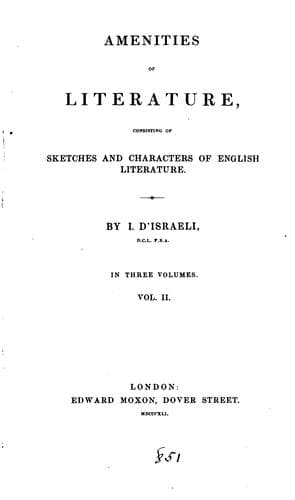
Amenities of Literature: Consisting of Sketches and Characters of English LiteratureDisraeli, Isaac
History
Amenities of Literature: Consisting of Sketches and Characters of English Literature
Disraeli, Isaac
Authors, English -- Biography; English literature -- History and criticism; Great Britain -- Intellectual life
It is to be regretted that Ascham held but an indolent pen. Yet it were
hard to censure the man for a cold neglect of his fame, who seems
equally to have neglected his fortune. Ascham has written little; and
all he left his family was "this little book" (The Schoolmaster), and
which he bequeathed to them, as the right way to good learning, "which,
if they follow, they shall very well come to sufficiency of living."
This was an age when the ingenious clung to a patron; the widow and the
son of Ascham found the benefits of this testamentary recommendation. It
must, however, be confessed to have been but a capricious legacy, for no
administrator might have been found to "the will." The age of patronage
was never that of independence to an author.
Johnson, in his admirable "Life of Ascham," observed, that "his
disposition was kind and social; he delighted in the pleasure of
conversation, and was probably not much inclined to business." It is
certain that he preferred old books to pounds sterling, for once he
requested to commute a part of his pension for a copy of the "Decem
Rhetores Græci," which he could not purchase at Cambridge. His frequent
allusions in his letters when abroad to "Mine Hostess Barnes," who kept
a tavern at Cambridge in the reign of Edward the Sixth, with tender
reminiscences of her "fat capons," and the "good-fellowship" there; and
further, his sympathy at the deep potation, when standing hard by the
emperor at his table, he tells us, "the emperor drank the best I ever
saw,--he had his head in the glass five times as long as any of us, and
never drank less than a good quart at once of Rhenish wine," and his
determination of providing "every year a little vessel of Rhenish" for
his cronies: and still further, his haunting the cockpit, and sometimes
trusting fortune by her dice, notwithstanding that he describes "dicing"
as "the green pathway of Hell;" all these _traits_ mark the boon
companion loving his leisure and his lounge.
When engaged in public life, a collegiate fellowship appeared to him to
offer supreme felicity. He writes thus,--"Ascham to his friends: who is
able to maintain his life at Cambridge, knows not what a felicity he
hath." Such was the conviction of one who had long lived in courts.
But when we consider that Ascham was Latin secretary to Edward the
Sixth, to Mary, and to Elizabeth, and intimately acquainted with the
transactions of these cabinets, with the sovereigns, and the ministers;
and during three years held a personal intercourse with the highest
foreign court;--we must regret, if we no not censure, the man who,
possessing these rare advantages, with a vigorous intellect, and a
felicitous genius, has left the world in silence. Assuredly, in Ascham,
we have lost an English Comines, who would have rivalled our few
memoir-writers, who, though with pens more industrious, had not eyes
more observant, nor heads more penetrating, than this secretary of three
sovereigns.
Public-domain text, read in full here on John Shaqi.
Reviews
Reviews
No reviews yet
Be the first to share your thoughts on this work.
Elsewhere in the archive
Join the Discussion
Join the discussion
Sign in to leave a comment or review.
Sign InorCreate an account