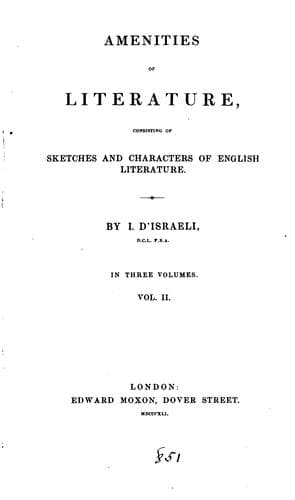
Amenities of Literature: Consisting of Sketches and Characters of English LiteratureDisraeli, Isaac
History
Amenities of Literature: Consisting of Sketches and Characters of English Literature
Disraeli, Isaac
Authors, English -- Biography; English literature -- History and criticism; Great Britain -- Intellectual life
There is, however, reason to conclude, that he himself was not
insensible to these higher claims which his station might have urged on
his genius and his diligence. Every night during his residence abroad,
which was of no short period, he was occupied by filling his Diary,
which has not, in any shape, come down to us. He has also himself told,
that he had written a book on "The Cockpit," one of the recreations of
"a courtly gentleman." We cannot imagine that such writings, by the hand
of Ascham, would be destroyed by his family, who knew how to value them.
A modern critic, indeed, considers it fortunate for Ascham's credit,
that this work on "The Cockpit" has escaped from publication. The
criticism is fallacious, for if an apology for cock-fighting be odious,
the author's reputation is equally hurt by the announcement as by the
performance. But the truth is, that such barbarous sports, like the
bear-baiting of England and the bull-fights of Spain, have had their
advocates. Queen Elizabeth had appointed Ascham her bear-keeper; and he
was writing in his character when disclosing the mysteries of the
cockpit. But the genius of our author was always superior to his
subject; and this was a treatise wherein he designed to describe "all
kinds of pastimes joined with labour used in open place, and in the
day-light." The curious antiquary, at least, must regret the loss of
Ascham's "Cockpit."
Ascham lived in the ferment of the Reformation: zealously attached to
the new faith under Edward the Sixth and Elizabeth, how did he preserve
himself during the intermediate reign, when he partook of the favours of
the papistical sovereign? His master and friend, the learned Sir John
Cheke, had only left for himself the choice of a recantation, or a
warrant for execution; but of Ascham's good fortune, nothing is known
but its mystery. The novel religion had, however, early heated the
passions, and narrowed the judgment, of Ascham. He wrote at a period
when the Romanist and the Protestant reciprocally blackened each other.
Ascham not only abhorred all Italians as papists, but all Italian books
as papistical. He invokes the interposition of the civil magistrate
against Petrarch and Boccaccio, whose volumes were then selling in every
shop. Baretti strikes at his manes with his stiletto-pen, in an animated
passage;[2] and Warton is indignant at his denunciation of our ancient
romances, of which the historian of our poetry says, "he has written in
the spirit of an early Calvinistic preacher, rather than as a sensible
critic and a polite scholar"--he who, in his sober senses, was eminently
both.
Public-domain text, read in full here on John Shaqi.
Reviews
Reviews
No reviews yet
Be the first to share your thoughts on this work.
Elsewhere in the archive
Join the Discussion
Join the discussion
Sign in to leave a comment or review.
Sign InorCreate an account