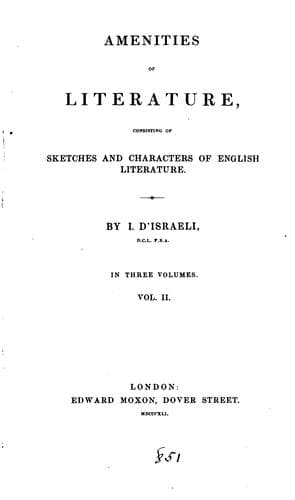
Amenities of Literature: Consisting of Sketches and Characters of English LiteratureDisraeli, Isaac
History
Amenities of Literature: Consisting of Sketches and Characters of English Literature
Disraeli, Isaac
Authors, English -- Biography; English literature -- History and criticism; Great Britain -- Intellectual life
In the days of the queen's father all "public interests" were
concentrated in the court-circle and its dependencies. The Parliament
was but the formal echo of the voice which came from the cabinet. The
learned Spelman has recorded that when the Lower House hesitated to pass
the bill for the dissolution of the monasteries, they were summoned into
the king's presence; and the Commons being first kept in waiting some
hours in his gallery, the king entered, looking angrily on one side and
then on the other: the dark scowl of the magnificent despot announced
his thoughts; and they listened to the thunder of his voice. "I hear,"
said he, "that my bill will not pass, but I will have it pass, or I will
have some of your heads."[1] I do not recollect whether it was on this
occasion that his majesty saluted his faithful Commons as "brutes!" but
the burly tyrant treated them as such. The penalty of their debates was
to be their heads; therefore this important bill passed _nemine
contradicente_!
However contemptuously this monarch regarded those who were within his
circle, he was sufficiently enlightened in the great national revolution
he meditated to desire to gain over the multitude on his side. The very
circumstance of the king allowing, as the letters patent run, "the free
and liberal use of the Bible in _our own natural English tongue_," was a
_coup-d'état_, and an evidence that Henry at one time designed to create
a people of readers on whom he counted to side with him. The people were
already possessed of the Reformation, before Henry the Eighth had
renounced the papacy. The reformers abroad had diligently supplied them
with versions of the Scriptures, and no small numbers of pamphlets
printed abroad in English were dispersed among the early "gospellers,"
the expressive distinction of the new heretics; a humble but fervent
rabble of tailors, joiners, weavers, and other handicraftsmen, who left
"the new for the old God," ready martyrs against the gross papistical
impostures, and many females theological, who turned away from the
corporal presence, and whom no bishop could seduce to curtsey to a
saint.
Public-domain text, read in full here on John Shaqi.
Reviews
Reviews
No reviews yet
Be the first to share your thoughts on this work.
Elsewhere in the archive
Join the Discussion
Join the discussion
Sign in to leave a comment or review.
Sign InorCreate an account