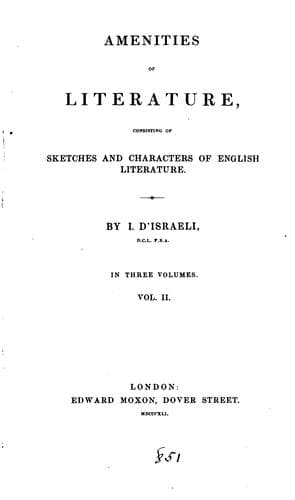
Amenities of Literature: Consisting of Sketches and Characters of English LiteratureDisraeli, Isaac
History
Amenities of Literature: Consisting of Sketches and Characters of English Literature
Disraeli, Isaac
Authors, English -- Biography; English literature -- History and criticism; Great Britain -- Intellectual life
Roger Ascham was truly what Pope has described Gay to have been, "in wit
a man, simplicity a child;" and he has developed his own character in
his letters. Latin and English, they are among the earliest specimens of
that domestic and literary correspondence in which the writer paints
himself without reserve, with all the warm touches of a free pencil, gay
sallies of the moment, or sorrows of the hour, confiding to the bosom of
a friend the secrets of his heart and his condition; such as we have
found in the letters of Gray and of Shenstone.
The works of Ascham, which are collected in a single volume, remain for
the gratification of those who preserve a pure taste for the pristine
simplicity of our ancient writers. His native English, that English
which we have lost, but which we are ever delighted to recover, after
near three centuries, is still critical without pedantry, and beautiful
without ornament: and, which cannot be said of the writings of Sir
THOMAS ELYOT and Sir THOMAS MORE, the volume of ASCHAM is indispensable
in every English library, whose possessor in any way aspires to connect
together the progress of taste and of opinion in the history of our
country.
FOOTNOTES:
[1] There were five editions of "The Scholemaster" within twenty
years of its first publication, of which that of 1573 is the most
correct and rare.--Dr. Valpy's "Cat."
[2] Baretti's "Account of the Manners of Italy," ii. 137--the most
curious work of this Anglo-Italian.
PUBLIC OPINION.
How long has existed that numerous voice which we designate as "Public
Opinion;" which I shall neither define nor describe?
The history of the English "people," considered in their political
capacity, cannot be held to be of ancient date. The civil wars of
England, and the intestine discords of the bloody Roses, seem to have
nearly reduced the nation to a semi-barbarous condition; disputed
successions, cruel factions, and family feuds, had long convulsed the
land, and the political disorganization had been as eventful as were,
not long after, the religious dissensions.
The grandfather of Elizabeth, Henry the Seventh, had terminated a
political crisis. It was his policy to weaken the personal influence of
the higher nobility, whose domination our monarchs had often fatally
experienced. This seems to have been the sole "public" concern of this
prudential and passionless sovereign, who, as the authority of the
potent aristocracy declined, established that despotic regality which
remained as the inheritance of the dynasty of the Tudors.
Public-domain text, read in full here on John Shaqi.
Reviews
Reviews
No reviews yet
Be the first to share your thoughts on this work.
Elsewhere in the archive
Join the Discussion
Join the discussion
Sign in to leave a comment or review.
Sign InorCreate an account