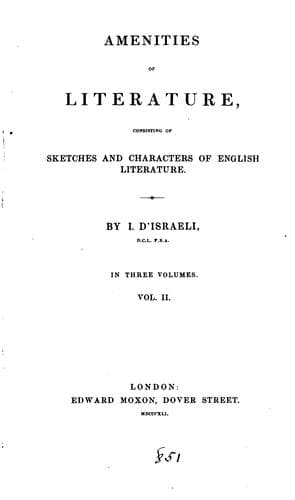
Amenities of Literature: Consisting of Sketches and Characters of English LiteratureDisraeli, Isaac
History
Amenities of Literature: Consisting of Sketches and Characters of English Literature
Disraeli, Isaac
Authors, English -- Biography; English literature -- History and criticism; Great Britain -- Intellectual life
The ancient, as well as the modern, of these scriptural poets has
adopted a narrative which is not found in the Scriptures. The rebellion
of Satan before the creation of man, and his precipitation with the
apostate angels into a dungeon-gulf of flame, and ice, and darkness,
though an incident familiar to us as a gospel text, remains nothing more
than a legend unhallowed by sacred writ.
Where are we, then, to seek for the origin of a notion universal
throughout Christendom? I long imagined that this revolt in heaven had
been one of the traditions hammered in the old rabbinical forge; and in
the Talmudical lore there are tales of the fallen angels; but I am
assured by a learned professor in these studies, that the Talmud
contains no narrative of "the Rebellion of Satan." The Hebrews, in their
sojourn in Babylon, had imbibed many Chaldean fables, and some fanciful
inventions. At this obscure period did this singular episode in sacred
history steal into their popular creed? Did it issue from that awful
cradle of monstrous imaginings, of demons, of spirits, and of terrifying
deities, Persia and India? In the Brahminical Shasters we find a
rebellion of the angels before the creation, and their precipitation
from light into darkness; their restoration by the clemency of the
Creator, however, occurs after their probationary state, during millions
of years in their metamorphoses on earth. But this seems only the veil
of an allegory designed to explain their dark doctrine of the
metempsychosis. The rebellion of the angels, as we have been taught it,
is associated with their everlasting chains and eternal fire; how the
legend became universally received may baffle inquiry.[5]
But the coincidence of the Cædmonian with the Miltonian poem in having
adopted the same peculiar subject of the revolt of Satan and the
expulsion of the angels, is not the most remarkable one in the two
works. The same awful narrative is pursued, and we are startled at the
opening of the Pandemonium by discovering the same scene and the same
actors. When we scrutinise into minuter parts, we are occasionally
struck by some extraordinary similarities.
Cædmon, to convey a notion of the ejection from heaven to hell, tells
that "the Fiend, with all his comrades, fell from heaven above, through
as long as _three nights and days_." Milton awfully describes Satan
"confounded, though immortal," rolling in the fiery gulf--
_Nine times the space that measures day and night_
To mortal men.
Cædmon describes the Deity having cast the evil angel into that "House
of perdition, down on that new bed; after, gave him a _name_ that the
highest (of the devils which they had now become) should be called
_Satan_ thenceforwards." Milton has preserved the same notice of the
origin of _the name_, thus--
To whom the _Arch-Enemy_,
And thence in heaven called _Satan_--
Satan in Hebrew signifying "the Enemy," or "the Adversary."
Public-domain text, read in full here on John Shaqi.
Reviews
Reviews
No reviews yet
Be the first to share your thoughts on this work.
Join the Discussion
Join the discussion
Sign in to leave a comment or review.
Sign InorCreate an account