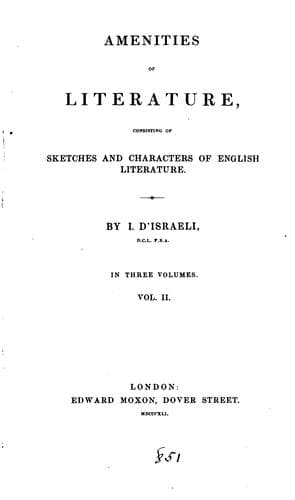
Amenities of Literature: Consisting of Sketches and Characters of English LiteratureDisraeli, Isaac
History
Amenities of Literature: Consisting of Sketches and Characters of English Literature
Disraeli, Isaac
Authors, English -- Biography; English literature -- History and criticism; Great Britain -- Intellectual life
[9] Miss Gurney, who has honourably been hailed as "the Elstob of her
age," privately printed her own close version of the "Saxon
Chronicle" from the printed text, 1810. Happy lady! who, when
sickness had made her its prisoner, opened the "Saxon Chronicle;" and
she learned that she might teach the learned.
The Rev. Dr. INGRAM, principal of Trinity College, Oxon, has since
published his translation, accompanied by the original, a collation
of the manuscripts, and notes critical and explanatory. 1823. 4to. A
volume not less valuable than curious.
THE PAGE, THE BARON, AND THE MINSTREL.
When learning was solely ecclesiastical and scholastical, there were no
preceptors for mankind. The monastery and the university were far
removed from the sympathies of daily life; all knowledge was out of the
reach of the layman. It was then that the energies of men formed a
course of practical pursuits, a system of education of their own. The
singular institution of chivalry rose out of a combination of
circumstances where, rudeness and luxury mingling together, the utmost
refinement was found compatible with barbaric grandeur, and holy justice
with generous power. In lawless times they invented a single law which
included a whole code--the law of knightly honour. _L'Ordenne de
Chevalerie_ is the morality of knighthood, and invests the aspirant with
every moral and political virtue as every military qualification.[1]
Destitute of a national education, the higher orders thus found a
substitute in a conventional system of manners. Circumstances, perhaps
originally accidental, became customs sealed with the sign of honour. In
this moral chaos order marshalled confusion, as refinement adorned
barbarism. A mighty spirit lay as it were in disguise, and it broke out
in the forms of imagination, passion, and magnificence, seeking their
objects or their semblance, and if sometimes mistaken, yet still laying
the foundations of social order and national glory in Europe.
A regular course of practical pursuits was assigned to the future noble
"childe" from the day that he left the parental roof for the baronial
hall of his patron. In these "nurseries of nobility," as Jonson has well
described such an institution, in his first charge as varlet or page,
the boy of seven years was an attendant at the baron's table, and it
was no humiliating office when the youth grew to be the carver and the
cupbearer. He played on the viol or danced in the brawls till he was
more gravely trained in "the mysteries of woods and rivers," the arts of
the chase, and the sciences of the swanery, and the heronry, and the
fishery; the springal cheerily sounded a blast of venery, or the
falconer with his voice caressed his attentive hawk, which had not
obeyed him had he neglected that daily flattery.
Public-domain text, read in full here on John Shaqi.
Reviews
Reviews
No reviews yet
Be the first to share your thoughts on this work.
Elsewhere in the archive
Join the Discussion
Join the discussion
Sign in to leave a comment or review.
Sign InorCreate an account