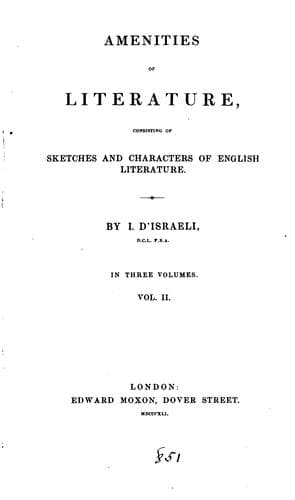
Amenities of Literature: Consisting of Sketches and Characters of English LiteratureDisraeli, Isaac
History
Amenities of Literature: Consisting of Sketches and Characters of English Literature
Disraeli, Isaac
Authors, English -- Biography; English literature -- History and criticism; Great Britain -- Intellectual life
At fourteen the varlet became an esquire, vaulting on his fiery steed,
and perfecting himself in all noble exercises, nicely adroit in the
science of "courtesie," or the etiquette of the court; and already this
"servant of love" was taught to elect _La dame de ses pensées_, and wore
her favour and her livery for "the love of honour, or the honour of
love," as Sir Philip Sydney in the style of chivalry expressed it.
At the maturity of twenty and one years the late varlet, and now the
esquire, stood forth a candidate to blazon his shield by knighthood--the
accomplished gentleman of these Gothic days, and right learned too, if
he can con his Bible and read his romance. Enchanting mirror of all
chivalry! if he invent songs and set them to his own melodies. Yet will
the gentle "batchelor" he dreaming on some gallant feat of arms, or some
martial achievement, whereby "to win his spurs." On his solemn entrance
into the church, laying his sword upon the altar, he resumed it by the
oath which for ever bound him to defend the church and the churchmen.
Thus all human affairs then were rounded by the ecclesiastical orbit,
out of which no foot dared to stray. All began and all ended as the
romances which formed his whole course of instruction--with the devotion
which seemed to have been addressed to man as much as to Heaven.
After the termination of the Crusades, the grand incident in the life of
the BARON was a pilgrimage to the holy city of Jerusalem; what the
penitent of the Cross had failed to conquer, it seemed a consolation to
kneel at and to weep over: a custom not obsolete so late as the reigns
of our last Henries; and still, though less publicly avowed, the
melancholy Jerusalem witnesses the Hebrew and the Christian performing
some secret vow, to grieve with a contrition which it seems they do not
feel at home.
In these peregrinations a lordly Briton might chance to find some French
or Italian knight as rash and as haughty; it was a law in chivalry that
a knight should not give way to any man who demanded it as a right, nor
decline the single combat with any knight under the sun; a challenge
could not therefore be avoided. But a _pas d'armes_ was not always a
friendly invitation, for often under the guise of chivalry was concealed
the national hostility of the parties.
Public-domain text, read in full here on John Shaqi.
Reviews
Reviews
No reviews yet
Be the first to share your thoughts on this work.
Elsewhere in the archive
Join the Discussion
Join the discussion
Sign in to leave a comment or review.
Sign InorCreate an account