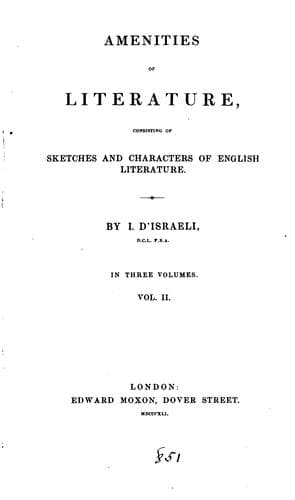
Amenities of Literature: Consisting of Sketches and Characters of English Literature — John Shaqi
Amenities of Literature: Consisting of Sketches and Characters of English LiteratureDisraeli, Isaac
History
Amenities of Literature: Consisting of Sketches and Characters of English Literature
Disraeli, Isaac
Authors, English -- Biography; English literature -- History and criticism; Great Britain -- Intellectual life
Among those shadows of time we grasp at one certainty. Whoever might be
the first-comers to this solitary island, when we obtain any knowledge
of the inhabitants, we are struck by their close resemblance to those
tribes of savage life whom our navigators have discovered, and who are
now found in almost a primitive state among that innumerable cluster of
what has recently been designated the Polynesian Isles. The aborigines
of Britain took the same modes of existence, and fell into similar
customs. We discover their rude population divided into jealous tribes,
in perpetual battle with one another; they lived in what Hobbes has
called the _status belli_, with no notion of the _meum_ and _tuum_; in
the same community of their women as was found in Otaheite;[4] and with
the same ignorance of property, when its representative in some form was
not yet invented. Our aborigines resembled these races even in their
personal appearance; a Polynesian chief has been drawn and coloured
after the life, and the figure exhibits the perfect picture of an
ancient Briton, almost naked, the body painted red; the British savage
chose blue, and made deep incisions in the flesh to insert his indelible
woad.[5] The fierce eye, and the bearded lip, with the long hair
scattered to the waist, exhibit the Briton as he was seen by Cæsar, and,
a century afterwards, as the British monarch Caractacus appeared before
the Emperor Claudius at Rome: his sole ornaments consisted of an iron
collar, and an iron girdle; but as his naked majesty had his skin
painted with figures of animals, however rudely, this was probably a
distinctive dress of British royalty. These Britons lived in thick
woods, herding among circular huts of reed, as we find other tribes in
this early state of society; and submissive to the absolute dominion of
a priesthood of magicians, as we find even among the Esquimaux; and
performing sanguinary rites, similar to those of the ancient Mexicans:
we are struck with the conviction that men in a parallel condition
remain but uniform beings.
Public-domain text, read in full here on John Shaqi.
Reviews
Reviews
No reviews yet
Be the first to share your thoughts on this work.
Join the Discussion
Join the discussion
Sign in to leave a comment or review.
Sign InorCreate an account