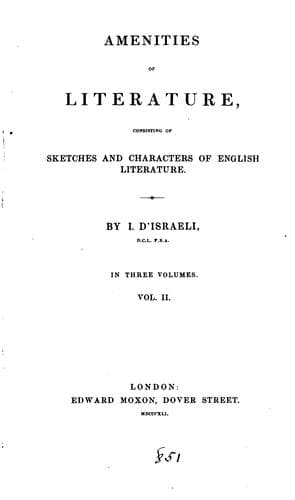
Amenities of Literature: Consisting of Sketches and Characters of English LiteratureDisraeli, Isaac
History
Amenities of Literature: Consisting of Sketches and Characters of English Literature
Disraeli, Isaac
Authors, English -- Biography; English literature -- History and criticism; Great Britain -- Intellectual life
Such a metrical Romance was a gift presented to royalty, when engrossed
by the rapturous hand of the Romancer himself; the autograph, in a
presentation copy, might count on the meed of "massy goblets" when the
munificent patron found the new volume delectable to his taste, which
indeed had been anticipated by the writer. This incident occurred to
Froissart in presenting his Romance to Richard the Second, when, in
reply to his majesty's inquiry after the contents, the author exultingly
told that "the book treated of Amour!"
To the writers of these ancient Romances we cannot deny a copious
invention, a variegated imagination, and, among their rambling
exuberances and their grotesque marvels, those enchanting enchantments
which the Greeks and Romans only partially and coldly raised. We may
often, too, discover that truth of human nature which is not always
supposed to lie hid in these desultory compositions. Amid their peculiar
extravagances, which at least may serve to raise an occasional smile,
the strokes of nature are abundant, and may still form the studies of
the writers of fiction, however they may hang on the impatience of the
writers and the readers of our duodecimos. Ancient writers are
pictorial: their very fault contributes to produce a remarkable
effect--a fulness often overflowing, but which at least is not a
scantiness leaving the vagueness of imperfect description. Their details
are more circumstantial, their impressions are more vivid, and they
often tell their story with the earnestness of persons who had conversed
with the actors, or had been spectators of the scene. We may be wearied,
as one might be at a protracted trial by the witnesses, but we are often
struck by an energetic reality which we sometimes miss in their
polished successors. Their copiousness, indeed, is without selection;
they wrote before they were critics, but their truth is not the less
truth because it is given with little art.
Public-domain text, read in full here on John Shaqi.
Reviews
Reviews
No reviews yet
Be the first to share your thoughts on this work.
Elsewhere in the archive
Join the Discussion
Join the discussion
Sign in to leave a comment or review.
Sign InorCreate an account