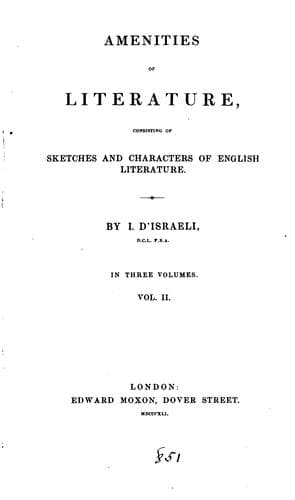
Amenities of Literature: Consisting of Sketches and Characters of English LiteratureDisraeli, Isaac
History
Amenities of Literature: Consisting of Sketches and Characters of English Literature
Disraeli, Isaac
Authors, English -- Biography; English literature -- History and criticism; Great Britain -- Intellectual life
The dilations of the metrical Romances into tomes of prose, Warton
considered as a proof of the decay of invention. Was not this censure
rather the feeling of a poet for his art, than the decision of a critic?
for the more extended scenes of the Romances in prose required a wider
stage, admitted of a fuller dramatic effect in the incidents, and a more
perfect delineation of the personages through a more sustained action.
If the prose Romances are not epics by the conventional code of the
Stagyrite, at least they are epical; and some rude Homers sleep among
these old Romancers, metrical or prosaic. A living poetic critic, one
best skilled to arbitrate, for he is without any prepossessions in
favour of our ancient writers, has honestly acknowledged their
faithfulness to nature in their touching simplicity; "nor," he adds, "do
they less afford, by their bolder imagination, adequate subjects for the
historical pencil." And he has more particularly noticed "Le bone
Florence de Rome,"--thus written by our ungrammatical minstrels.
"Classical poetry has scarcely ever conveyed in shorter boundaries so
many interesting and complicated events as may be found in this good old
Romance."[8] This indeed is so true, that we find these romantic tales
were not only recited or read, but their subjects were worked into the
tapestries which covered the walls of their apartments. The Bible and
the Romance equally offered subjects to eyes learned in the "Estoires"
never to be forgotten.
Our master poets have drawn their waters from these ancient fountains.
SIDNEY might have been himself one of their heroes, and was no unworthy
rival of his masters: SPENSER borrowed largely, and repaid with
munificence: MILTON in his loftiest theme looked down with admiration on
this terrestrial race,
-----------and what resounds
In fable or romance of Uther's son,
Begirt with British or Armoric knights.
"In 'Amadis of Gaul,'" has said our true laureate, "may be found the
Zelmane of the 'Arcadia,' the Masque of Cupid of the 'Faery Queen,' and
the Florizel of the 'Winter's Tale.' Sidney, Spenser, and Shakspeare
imitated this book: was ever book honoured by three such imitators?"[9]
Public-domain text, read in full here on John Shaqi.
Reviews
Reviews
No reviews yet
Be the first to share your thoughts on this work.
Elsewhere in the archive
Join the Discussion
Join the discussion
Sign in to leave a comment or review.
Sign InorCreate an account