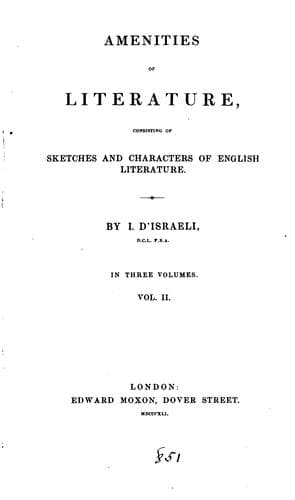
Amenities of Literature: Consisting of Sketches and Characters of English LiteratureDisraeli, Isaac
History
Amenities of Literature: Consisting of Sketches and Characters of English Literature
Disraeli, Isaac
Authors, English -- Biography; English literature -- History and criticism; Great Britain -- Intellectual life
We cannot think less than Père Hardouin that there were no poetical and
imaginative monks--Homers in cowls, and Virgils who chanted vespers--who
could compose in their unoccupied day more beautiful romances than their
crude legends, or the dry annals of the Leiger book of their abbey. Some
knowledge these writers had of the mythological, and even the Homeric
and Virgilian fictions, for they often gave duplicates of the classical
fables of antiquity. Circe was a fair sorceress, the one-eyed Polyphemus
a dread giant, and Perseus bestrode a winged dragon, before they were
reflected in romances. But what we discover peculiar in these works is a
strange mixture of sacred and profane matters, always treated in a
manner which scents of the cloister. Before he enters the combat, the
knight is often on his knees, invoking his patron-saint; he proffers his
vows on holy relics; while ladies placed in the last peril, or the most
delicate positions, by their fervent repetitions of the sign of the
cross, or a vow to found an abbey, are as certainly saved: and for
another refined stroke of the monachal invention, the heroes often close
their career in a monastery or a hermitage. The monkish morality which
sat loosely about them was, however, rigid in its ceremonial discipline.
Lancelot de Lac leaves the bed of the guilty Genevra, the Queen of the
good king Arthur, at the ring of the matin-bell, to assist at mass; so
scrupulous were such writers that even in criminal levities they should
not neglect all the offices of the Church. The subject of one of these
great romances is a search after the cup which held the real blood of
Christ; and this history of the _Sang-real_ forms a series of romances.
Who but a monk would have thought, and even dared to have written it
down, that all the circumstances in this romance were not only certain,
but were originally set down by the hand of Jesus himself? and further
dared to observe, that Jesus never wrote but twice before--the Lord's
Prayer, and the sentence on the woman taken in adultery. Such a pious,
or blasphemous fraud, was not unusual among the dark fancies of the
monastic legendaries.
Some of these Homers must have left their lengthening Iliad, as Homer
himself seems to have done, unfinished; tired, or tiring, for no doubt
there was often a rehearsal, "the tale half told" was resumed by some
Elisha who caught the mantle his more inspired predecessor had let fall.
It appears evident that several were the continuators of a favourite
romance; and from deficient attention or deficient skill a fatal
discrepancy has been detected in the identical characters--the ordinary
fate of those who write after the ideas of another, with indistinct
conceptions, or with fancies going contrary to those of the first
inventor.
Public-domain text, read in full here on John Shaqi.
Reviews
Reviews
No reviews yet
Be the first to share your thoughts on this work.
Elsewhere in the archive
Join the Discussion
Join the discussion
Sign in to leave a comment or review.
Sign InorCreate an account