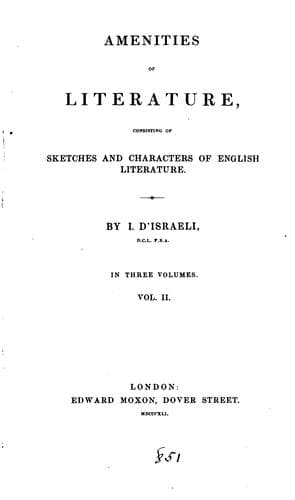
Amenities of Literature: Consisting of Sketches and Characters of English LiteratureDisraeli, Isaac
History
Amenities of Literature: Consisting of Sketches and Characters of English Literature
Disraeli, Isaac
Authors, English -- Biography; English literature -- History and criticism; Great Britain -- Intellectual life
These metrical romances in manuscript, and the printed prose in their
original editions, are now very costly. By the antiquary and the poet
these tomes may be often opened. With the antiquary they have served as
the veritable registers of their ages. The French antiquaries, and Carte
in England, have often illustrated by those ancient romances many
obscure points in geography and history. Except in the mere machinery of
their fancy, these writers had no motive to pervert leading facts, for
these served to give a colour of authenticity to their pretended
history, or to fix their locality. As they had not the erudition to
display, nor were aware of the propriety of copying, the customs and
manners of the age of their legendary hero, they have faithfully
transmitted their own; we should never have had but for this lucky
absurdity the "Tale of Thebes" turned into a story of the middle ages;
while Alexander the Great is but the ideal of a Norman baron in the
splendour and altitude of the conception of the writers. It was the
ignorance of the illuminators of our Latin and Saxon manuscripts of any
other country than their own which enabled STRUTT to place before the
eye a pictorial exhibition of our Anglo-Saxon fathers. Compared with the
realities of these originals, with all their faults of tediousness, the
modern copiers of ancient times, in their mock scenes of other ages, too
often reflect in the cold moonlight of their fancy a shadowy
unsubstantial antiquity.
The influence of these fabulous achievements of unconquerable heroes and
of self-devoted lovers over the intellect and the passions of men and
women, during that vast interval of time when they formed the sole
literature, was omnipotent. In the early romances of chivalry, when
their genius was purely military, and directed to kindle a passion for
joining the crusades, we rarely find adventures of the tender passion;
but, since women cannot endure neglect, and the female character has all
the pliancy of sympathy, and has performed her part in every age on the
theatre of society, we discover the extraordinary fact that many ladies
assumed the plumy helmet and dexterously managed the lance. The ladies
rode amid armed knights resistless as themselves. It was subsequently,
when we find that singularly fantastic institution of "The Courts of
Love," which delivered their "Arrets" in the style of a most refined
jurisprudence, that these beautiful companions-at-arms were satisfied to
conquer the conquerors by more legitimate seductions, and that the
romances told of little but of loves. Ariosto and Tasso are supposed to
have drawn their female warriors from the Amazonian Penthesilea and the
Camilla of Homer and Virgil; but it would seem that the prototype of
these feminine knights these poets also found among those old romances
which they loved.
Public-domain text, read in full here on John Shaqi.
Reviews
Reviews
No reviews yet
Be the first to share your thoughts on this work.
Elsewhere in the archive
Join the Discussion
Join the discussion
Sign in to leave a comment or review.
Sign InorCreate an account