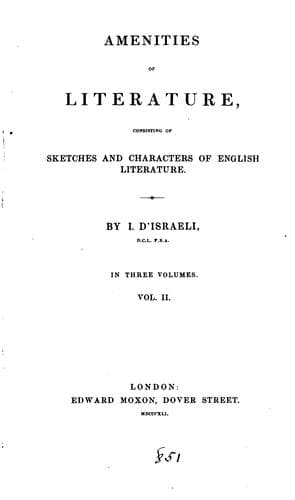
Amenities of Literature: Consisting of Sketches and Characters of English LiteratureDisraeli, Isaac
History
Amenities of Literature: Consisting of Sketches and Characters of English Literature
Disraeli, Isaac
Authors, English -- Biography; English literature -- History and criticism; Great Britain -- Intellectual life
[10] One of the most celebrated romantic histories is "the Troy-book
of Guido delle Colonne," which has been considered as the original of
all the later tales of Troy. On the acute suggestion of Tyrwhit,
Douce ascertained that this fabulous history, by many regarded as
original, is only a Latin translation of a Norman poet,* which Guido
passes off as a history collected from Dares and other fictitious
authorities, but disingenuously conceals the name of Benoit de Saint
Maur, whose works he appears to have found when he came to England.
It was a prevalent practice in the middle ages to appropriate a work
by a cautious suppression of any mention of the original. Tiraboschi
might now be satisfied that Guido delle Colonne was in England, which
he doubted, since he now stands charged with only turning into Latin
prose the poem of a Norman, that is, an English poet at the court of
our Henry the Second.
* Douce's "Illustrations of Shakspeare."
[11] In the curious catalogue of these romances in the Roxburgh
Library, the cataloguer announced three or four of these pretended
authors as "names unknown to any literary historians," and considered
the announcement a literary discovery.
[12] Père Menestrier, "Chevalerie Ancienne et Moderne," chap. v. On
HERALDS.
[13] See Bentham's "History and Antiquities of Ely," 27.
ORIGIN OF THE VERNACULAR LANGUAGES OF EUROPE.
The predominance of the Latin language, during many centuries, retarded
the cultivation of the vernacular dialects of Europe. When the barbarous
nations had triumphed over ancient Rome, the language of the Latins
remained unconquered; that language had diffused itself with the
universal dominion, and, living in the minds of men, required neither
legions nor consuls to maintain its predominance.
From accident, and even from necessity, the swarming hordes, some of
whom seem to have spoken a language which had never been written, and
were a roving people at a period prior to historical record, had adopted
that single colloquial idiom which their masters had conveyed to them,
attracted, if not by its beauty, at least by its convenience. This
vulgar Latin was not, indeed, the Latin of the great writers of
antiquity; but in its corrupt state; freed from a complex construction,
and even from grammar, had more easily lent itself to the jargon of the
ruder people. Teutonic terms, or Celtic words with corrupt latinisms,
were called "the scum of ancient eloquence, and the rust of vulgar
barbarisms," by an indignant critic in the middle of the fifth
century.[1] It was amid this confusion of races, of idioms, and of
customs, that from this heterogeneous mass were hewed out those
VERNACULAR DIALECTS of Europe which furnished each people with their own
idiom, and which are now distinguished as the MODERN LANGUAGES.
Public-domain text, read in full here on John Shaqi.
Reviews
Reviews
No reviews yet
Be the first to share your thoughts on this work.
Elsewhere in the archive
Join the Discussion
Join the discussion
Sign in to leave a comment or review.
Sign InorCreate an account