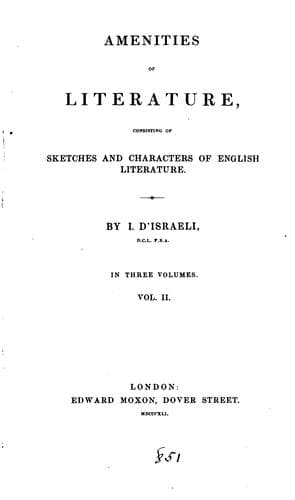
Amenities of Literature: Consisting of Sketches and Characters of English LiteratureDisraeli, Isaac
History
Amenities of Literature: Consisting of Sketches and Characters of English Literature
Disraeli, Isaac
Authors, English -- Biography; English literature -- History and criticism; Great Britain -- Intellectual life
In this transference and transfusion of languages, Italy retained the
sonorous termination of her paternal soil, and Spain did not forget the
majesty of the Latin accent; lands favoured by more genial skies, and
men blessed with more flexible organs. But the Gothic and the Northern
races barbarously abbreviated or disfigured their Latin words--to sounds
so new to them they gave their own rude inflections; there is but one
organ to regulate the delicacy of orthoepy--a musical and a tutored ear.
The Gaul,[2] in cutting his words down, contracted a nasal sharpness;
and the Northmen, in the shock of their hard, redundant consonants, lost
the vowelly confluence.
This vulgar or corrupt Latin, mingled with this diversity of jargons,
was the vitiated mother of the sister-languages of Europe--sisters still
bearing their family likeness, of the same homely origin, but of various
fortunes, till some attained to the beauty and affluence of their Latin
line. From the first the people themselves had dignified their spurious
generation of language as _Romans_, or _Romance_, or _Romaunt_, still
proud perhaps of its Roman source; but the critical Latins themselves
had distinguished it as _Rustic_, to indicate a base dialect used only
by those who were far removed from the metropolis of the world.
But when these different nations had established their separate
independence, this vernacular idiom was wholly left to the people; it
was the image of their own barbaric condition, unworthy of the studies,
and inadequate to the genius, of any writer. The universal language
maintained its pre-eminence over the particular dialect, and as the
course of human events succeeded in the overwhelming of ancient Rome,
another Rome shadowed the world. Ecclesiastical Rome, whence the novel
faith of Christianity was now to emanate, far more potent than military
Rome, perpetuated the ancient language. The clergy, through the
diversified realms of Europe, were held together in strict conformity,
and by a common bond chained to the throne of the priesthood--one faith,
one discipline, one language!
The Latin tongue, both in verse and prose, was domiciliated among people
of the most opposite interests, customs, and characters. The primitive
fathers, the later schoolmen, the monkish chroniclers, all alike
composed in Latin; all legal instruments, even marriage-contracts, were
drawn in Latin: and even the language of Christian prayer was that of
abolished paganism.
Public-domain text, read in full here on John Shaqi.
Reviews
Reviews
No reviews yet
Be the first to share your thoughts on this work.
Elsewhere in the archive
Join the Discussion
Join the discussion
Sign in to leave a comment or review.
Sign InorCreate an account