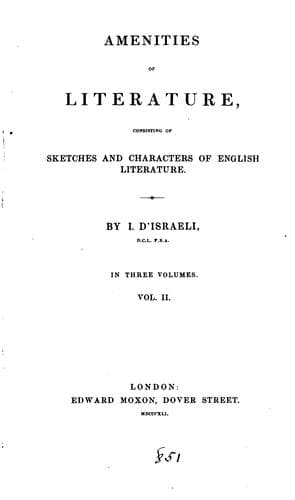
Amenities of Literature: Consisting of Sketches and Characters of English LiteratureDisraeli, Isaac
History
Amenities of Literature: Consisting of Sketches and Characters of English Literature
Disraeli, Isaac
Authors, English -- Biography; English literature -- History and criticism; Great Britain -- Intellectual life
The idiom of their father-land--or as we have affectionately called it,
our "mother-tongue," and as our ancient translator of the
"Polychronicon" energetically terms it, "the birth-tongue"--those first
human accents which their infant ear had caught, and which from their
boyhood were associated with the most tender and joyous recollections,
every nation left to fluctuate on the lips of the populace, rude and
neglected. Whenever a writer, proposing to inform the people on subjects
which more nearly interested them, composed in the national idiom, it
was a strong impulse only which could induce him thus to submit to
degrade his genius. One of the French crusaders, a learned knight, was
anxious that the nation should become acquainted with the great
achievements of the deliverers of Jerusalem; it was the command of his
bishop that induced him to compose the narrative in the vernacular
idiom; but the twelve years which he bestowed on his chronicle were not
considered by him as employed for his glory, for he avows that the
humiliating style which he had used was the mortifying performance of a
religious penance.
All who looked towards advancement in worldly affairs, and were of the
higher orders in society, cultivated the language of Rome. It is owing
to this circumstance, observes a learned historian of our country, that
"the Latin language and the classical writers were preserved by the
Christian clergy from that destruction which has entirely swept from us
the language and the writings of Phoenicia, Carthage, Babylon, and
Egypt."[3] We must also recollect that the influence of the Latin
language became far more permanent when the great master-works of
antiquity were gradually unburied from their concealments. In this
resurrection of taste and genius, they derived their immortality from
the imperishable soul of their composition. All Europe was condemned to
be copiers, or in despair to be plagiarists.
It is well known how the admirable literatures of Greece and Rome struck
a fresh impulse into literary pursuits at that period which has been
distinguished as the restoration of letters. The emigration of the
fugitive Greeks conveyed the lost treasures of their more ancient
literature to the friendly shores of Italy. Italy had then to learn a
new language, and to borrow inspiration from another genius.
Public-domain text, read in full here on John Shaqi.
Reviews
Reviews
No reviews yet
Be the first to share your thoughts on this work.
Elsewhere in the archive
Join the Discussion
Join the discussion
Sign in to leave a comment or review.
Sign InorCreate an account