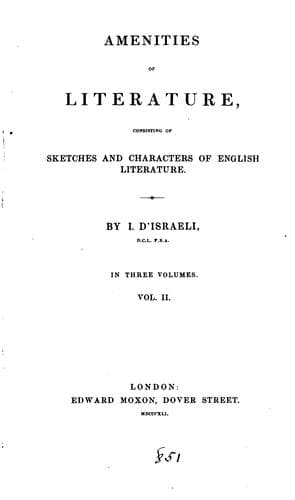
Amenities of Literature: Consisting of Sketches and Characters of English LiteratureDisraeli, Isaac
History
Amenities of Literature: Consisting of Sketches and Characters of English Literature
Disraeli, Isaac
Authors, English -- Biography; English literature -- History and criticism; Great Britain -- Intellectual life
It is remarkable of those writers who had already distinguished
themselves by their Latin works, that when they began to compose in
their native language, those classical effusions on which they had
confidently rested their future celebrity sank into oblivion; and the
writers themselves ceased to be subjects either of critical inquiry or
of popular curiosity, except in that language in which they had opened a
vein of original thought, in a manner and diction the creation of their
own feelings. Here their natural power and their freed faculties placed
them at a secure interval from their imitators. Modern writers in Latin
were doomed to find too many academical equals; but those who were
inimitable in their vernacular idiom could dread no rival, and
discovered how the productions of the heart, rather than those of the
lexicon, were echoed to their authors in the voice of their
contemporaries.
The people indeed were removed far out of the influence of literature.
The people could neither become intelligent with the knowledge, nor
sympathise with the emotions, concealed in an idiom which had long
ceased to be spoken, and which exacted all the labour and the leisure of
the cloistered student.
This state of affairs had not occurred among the Greeks, and hardly
among the Romans, who had only composed their immortal works in their
maternal tongue. Their arts, their sciences, and their literature were
to be acquired by the single language which they used. It was the
infelicity of their successors in dominion, to weary out the tenderness
of youth in the repulsive labours of acquiring the languages of the two
great nations whose empire had for ever closed, but whose finer genius
had triumphed over their conquerors.
With the ancients, instruction did not commence until their seventh
year; and till they had reached that period Nature was not disturbed in
her mysterious workings: the virgin intellect was not doomed to suffer
the violence of our first barren studies--that torture of learning a
language which has ceased to be spoken by the medium of another equally
unknown. Perhaps it was owing to this favourable circumstance that,
among the inferior classes of society in the two ancient nations, their
numerous slaves displayed such an aptitude for literature, eminent as
skilful scribes, and even as original writers.
Public-domain text, read in full here on John Shaqi.
Reviews
Reviews
No reviews yet
Be the first to share your thoughts on this work.
Elsewhere in the archive
Join the Discussion
Join the discussion
Sign in to leave a comment or review.
Sign InorCreate an account