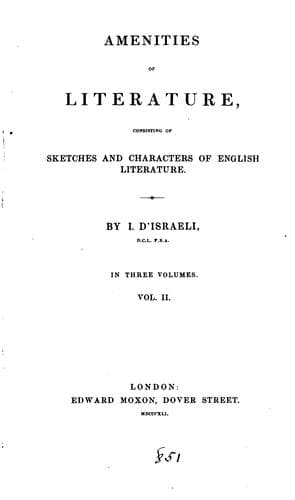
Amenities of Literature: Consisting of Sketches and Characters of English LiteratureDisraeli, Isaac
History
Amenities of Literature: Consisting of Sketches and Characters of English Literature
Disraeli, Isaac
Authors, English -- Biography; English literature -- History and criticism; Great Britain -- Intellectual life
One of the earliest prose writers in our language when style was
beginning to be cultivated, has aptly described, by a domestic but
ingenious image, the effect of our youth gathering the burdens of
grammatical faggots in the Sylva of antiquity. It is Sir THOMAS ELYOT
who speaks, in "The Boke of the Governor," printed in 1531: "By that
time the learner cometh to the most sweet and pleasant rendering of old
authors, the sparks of fervent desire are extinct with the burthen of
grammar, like as a little fire is even quenched with a great heap of
small sticks, so that it can never come to the principal logs, where it
should burn in a great pleasant fire."
It was Italy, the Mother and the Nurse of Literature (as the filial zeal
of her sons has hailed her), which first opened to the nations of Europe
the possibility of each creating a vernacular literature, reflecting
the image not of the Greeks and of the Romans, but of themselves.
Three memorable men, of the finest and most contrasted genius, appeared
in one country and at one period. With that contempt for the language of
the people in which the learned participated, busied as they were at the
restoration of letters by their new studies and their progressive
discoveries, PETRARCH contemned his own Italian "Rime," and was even
insensible to the inspiration of a mightier genius than his own,--that
genius who, with a parental affection, had adopted the orphan idiom of
his father-land; an orphan idiom, which had not yet found even a name;
for it was then uncertain what was the true language of Italy. DANTE had
at first proposed to write in Latin; but with all his adoration of his
master Virgil, he rejected the verse of Virgil, and anticipated the
wants of future ages. A peculiar difficulty, however, occurred to the
first former of the vernacular literature of Italy. In the state of this
unsettled language--composed of fragments of the latinity of a former
populace, with the corruptions and novelties introduced by its new
masters--deformed by a great variety of dialects--submitted, in the
mouths of the people, to their caprices, and unstamped by the hand of a
master--it seemed hopeless to fix on any idiom which, by its inherent
nobleness, should claim the distinguished honour of being deemed
Italian. DANTE denied this envied grace to any of the rival
principalities of his country. The poet, however, mysteriously asserted
that the true Italian "volgare" might be discovered in every Italian
city; but being common to all, it could not be appropriated by any
single one. Dante dignified the "volgare illustre" which he had
conceived in his mind, by magnificent titles;--it was "illustrious," it
was "cardinal," it was "aulic," it was "courtly," it was the language of
the most learned who had composed in the vulgar idiom, whether in
Sicily, in Tuscany, in Puglia, even in Lombardy, or in the marshes of
Ancona! This fanciful description of the Italian language appeared
Public-domain text, read in full here on John Shaqi.
Reviews
Reviews
No reviews yet
Be the first to share your thoughts on this work.
Elsewhere in the archive
Join the Discussion
Join the discussion
Sign in to leave a comment or review.
Sign InorCreate an account